Olimpia: A Coffee House and Gallery in Casco Viejo, Panama That Quietly Changes the Standard
The Discovery of a Coffee Shop in Casco Viejo, Panama
A couple of weeks ago, I was setting up a time to meet with Robin from Amarla Hotel and Kaandela.
It is usually a simple routine. We meet, have a coffee, and catch up on what is happening in the area. That morning, however, he asked me something different.
“Have you been to Olimpia yet?”
I told him I had not, although I had heard the name mentioned a couple of times. In Casco Viejo, Panama, new places open regularly, and over time, you learn not to rush to judgment. Some settle in quickly, others take time, and a few never quite find their footing.
Robin did not hesitate. He simply said, “Let’s go. I think you will like it.”
We walked over toward the Flat Arch, only a minute away, and as we approached, I remember asking, “Is it right here?” He nodded and mentioned that the family owns the building and that Paulo had been working quietly on the lower level, putting something together without much noise around it.
There was no buildup. No introduction. No expectation.
We opened the door and walked in.
And I stopped.


Walking In: First Impressions OF Olimpia Coffee Shop in Casco Viejo, Panama
When you have spent a lifetime in hospitality, you develop an instinct for space. Within a few seconds, you can usually tell whether something has been overdesigned or whether it has found its balance.
Olimpia does not try to impress you, but it does.
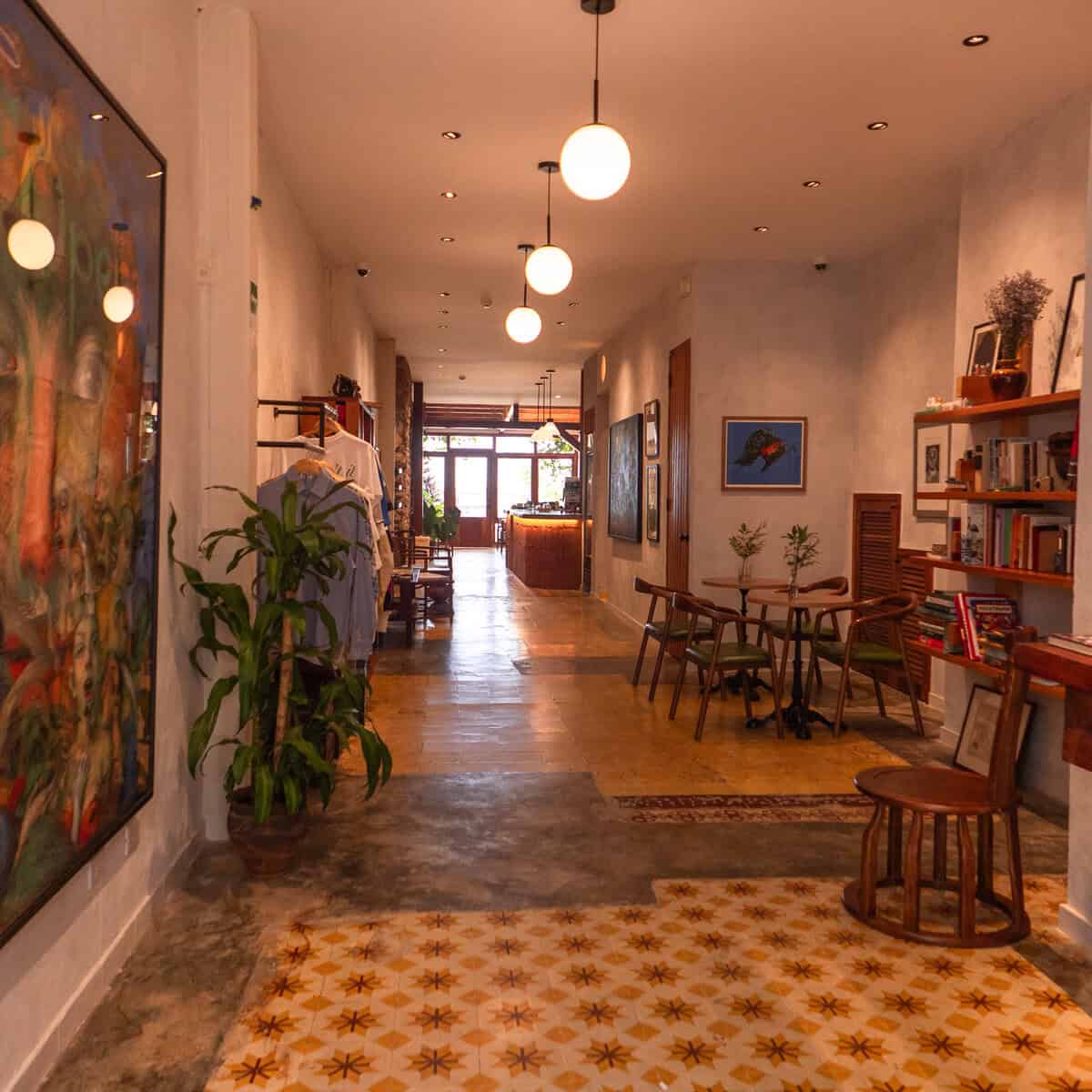
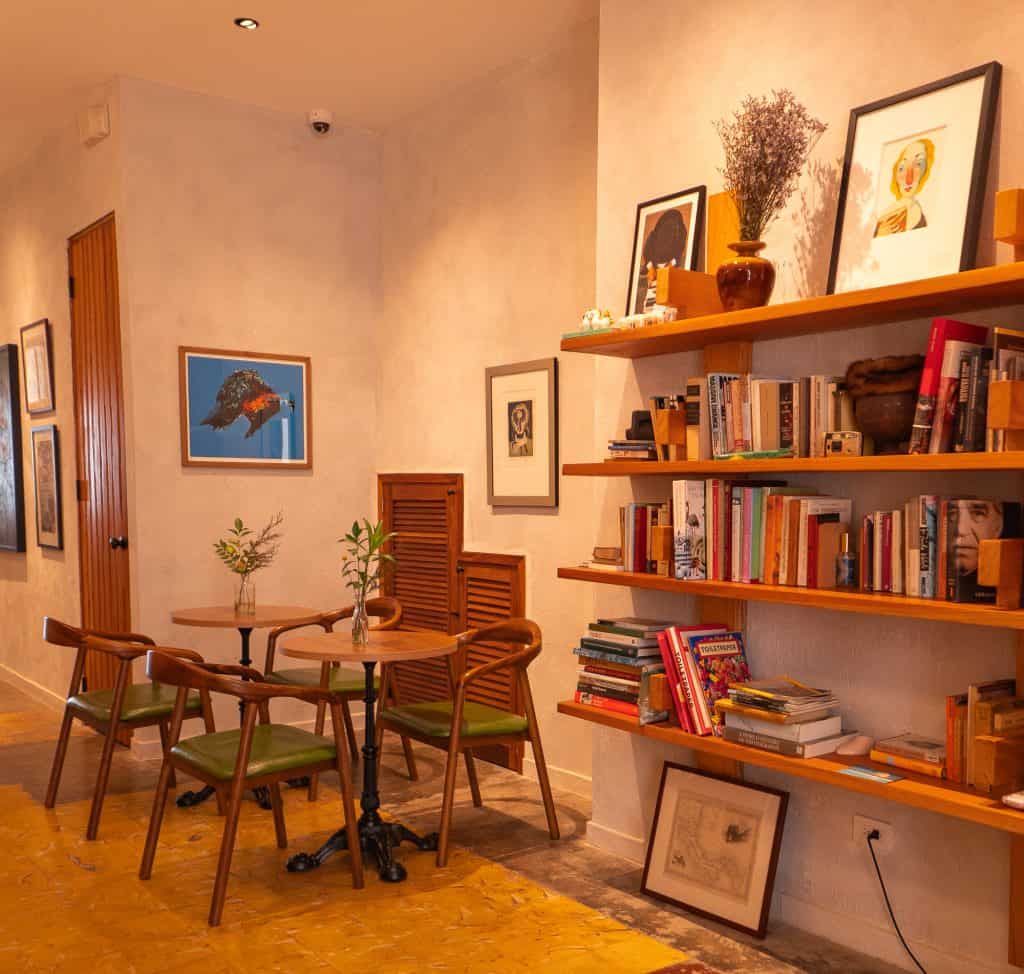
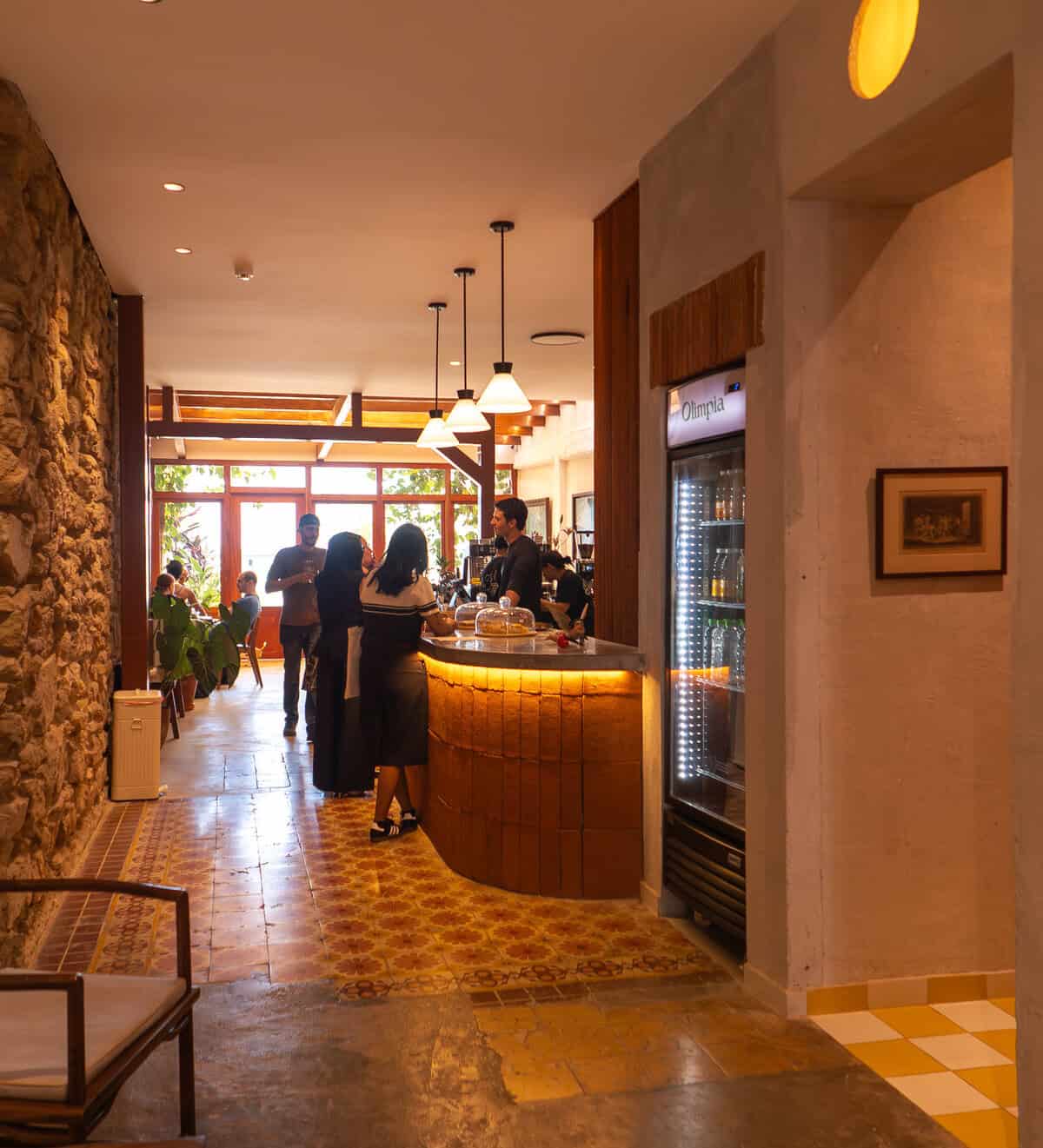
The entrance is wide, filled with natural light, and immediately comfortable. There is artwork on the walls, but it does not compete for attention. Instead, your eye moves toward the bookshelves, which are carefully arranged and paired with small tables and chairs that feel intentional rather than decorative.
There is a clothing rack off to one side, understated and placed in a way that feels natural within the room. Nothing is forced. Nothing feels like it has been added as an afterthought.
As you move further into this coffee shop in Casco Viejo, Panama, the space opens up before you even reach the counter. That is the moment when you begin to understand that this is not a typical layout.
It is doing something different.
A Space Designed to Slow You Down
Most coffee shops are built around efficiency. You walk in, you order, and you move along. The entire experience is structured to keep things moving.
Olimpia takes the opposite approach.
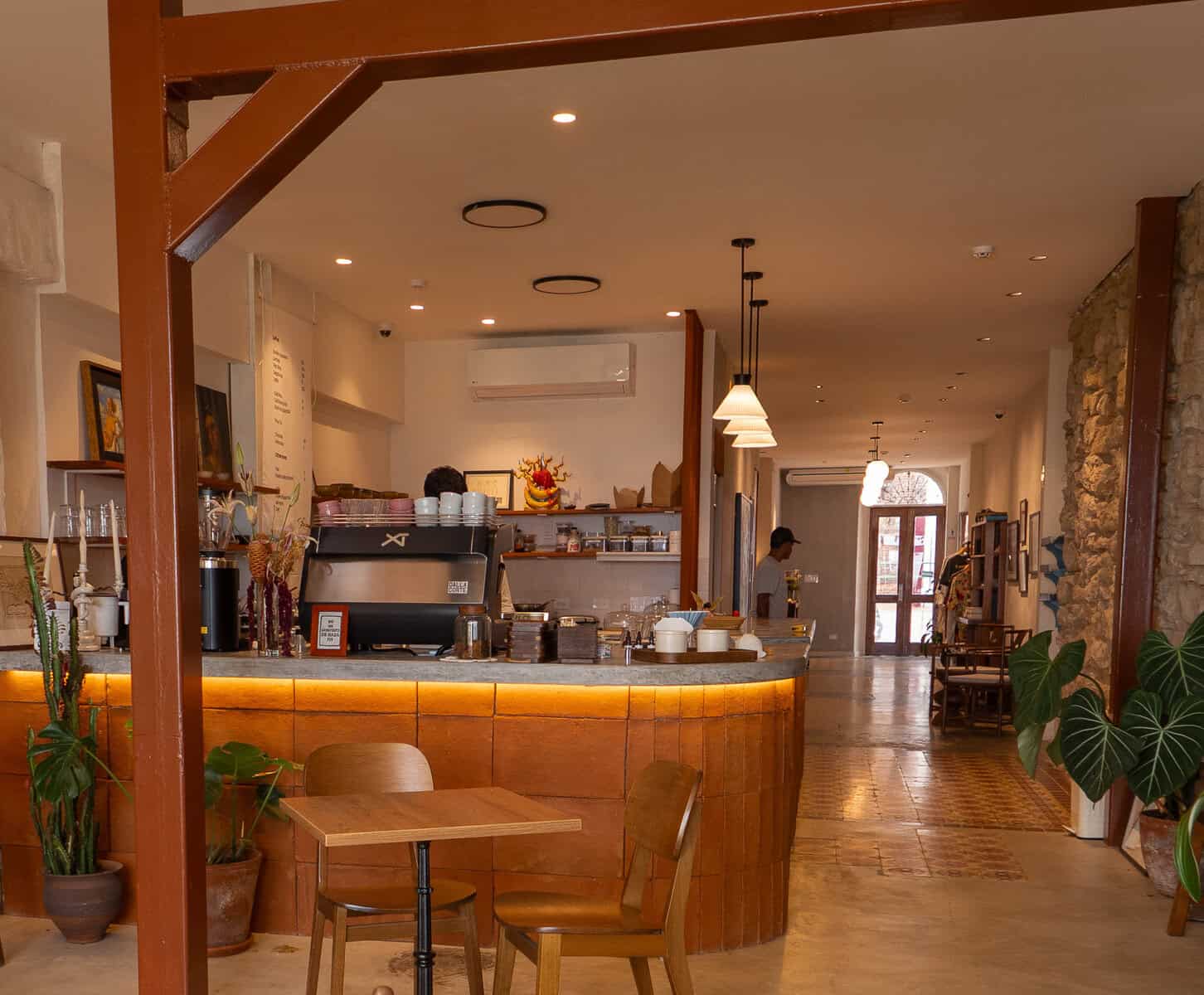
Here, the seating comes first, and the experience begins before you ever think about ordering a coffee. Soft furniture, upright chairs, and small tables are arranged with intention, creating a series of comfortable spaces rather than a room built for turnover.
That subtle shift changes the entire dynamic.
You are not being processed. You are being invited to stay.
Light filters in through a wall of windows that draws your attention toward the patio, where greenery softens the edges of the space and opens up a view across the water. From there, you can see the Biomuseo in the distance, with ships moving slowly beyond it.
It is one of those quiet moments that reminds you exactly where you are, while at the same time allowing you to step away from it.
Inside, everything feels calm. Outside, the world continues to move.
That balance is not easy to create, and it is even harder to sustain. Yet Olimpia, as a coffee shop in Casco Viejo, Panama, manages to hold that line with a sense of ease that feels natural rather than constructed.
You come in for a coffee, but you find yourself staying longer than you expected.


Something Is Changing in Casco Viejo
Sitting there, I found myself thinking about how much Casco Viejo has changed over the years and, more importantly, how it is continuing to evolve.
Not in obvious ways, and not in the kind of developments that attract headlines, but in the people who are now stepping forward to create new spaces.
Over time, I have seen different phases in this neighborhood. Early restorations, first-time operators, and outside concepts trying to establish themselves. Many of those efforts were built around clear commercial objectives, which is understandable, as that is the nature of the business.
What feels different now is the intention behind what is being created.
There is a younger generation emerging in Casco Viejo, Panama, people who have traveled extensively and experienced how other cities approach coffee, design, and culture. They have seen environments where spaces are allowed to breathe and where the experience is not rushed.
Olimpia reflects that shift.
It does not define itself in a single sentence, and it does not try to position itself as something it is not. Instead, it brings together coffee, art, and design in a way that feels balanced and unforced.
What makes Olimpia stand out among coffee shops in Casco Viejo, Panama, is not just what it offers, but how it makes you feel while you are there.
For a long time, development in areas like Casco Viejo has been shaped by what people believe visitors expect. Now, there is a movement toward creating spaces based on how people actually want to live and spend time.
That difference may seem subtle, but it is significant.
It is the difference between building a business and creating a place that people return to.
Meeting Paulo Alfaro
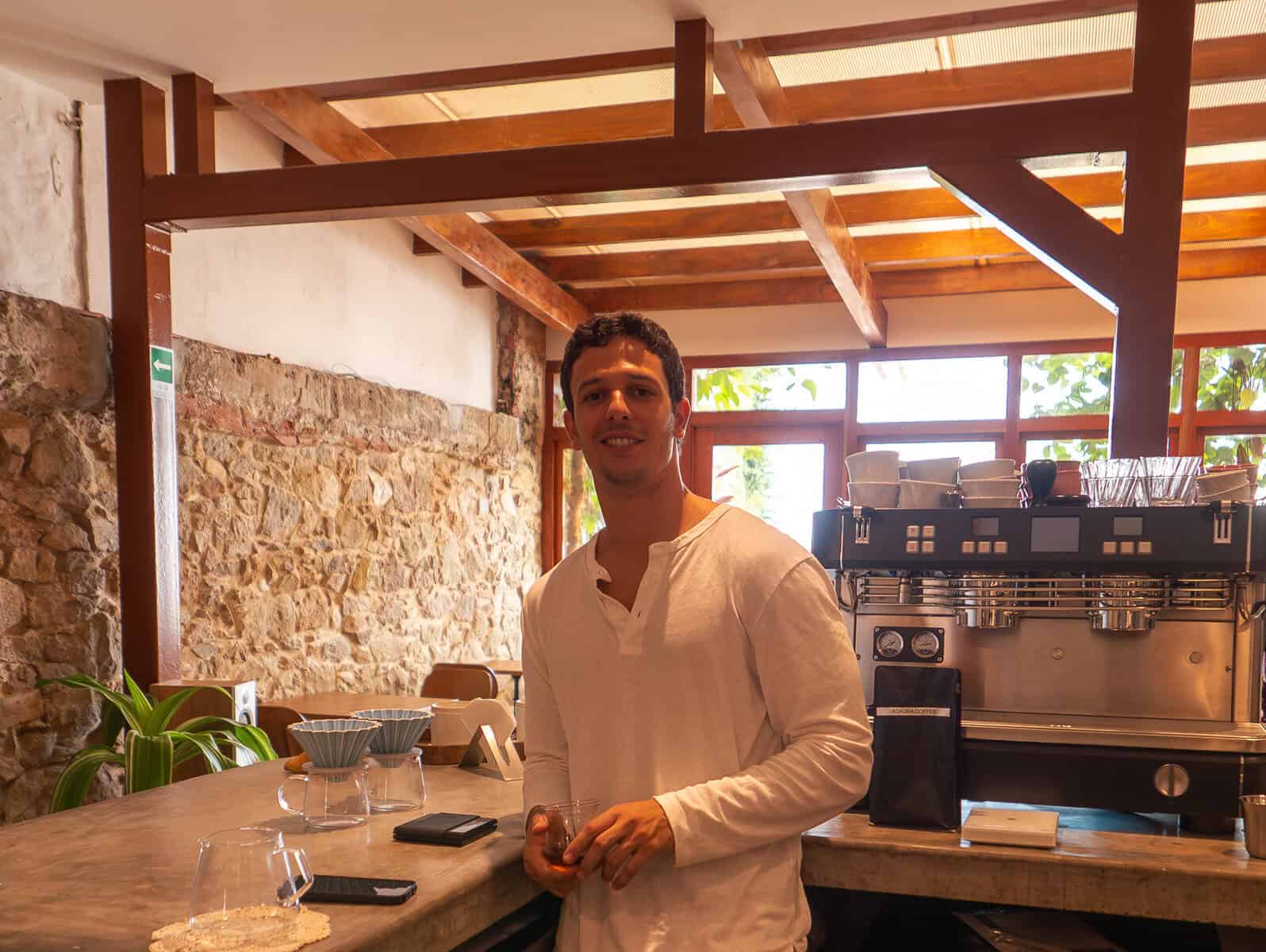
It was not long after we sat down that a young man approached the table and introduced himself as Paulo Alfaro.
There was a natural ease about him from the start. He was warm, direct, and comfortable in the space he had created, without any sense of needing to explain or justify it. At that point, he did not know who I was or what I did, which made the interaction feel even more genuine.
In hospitality, you learn to recognize the difference between someone who is managing an impression and someone who is simply present. Paulo was present.
The name itself stood out immediately.
Alfaro is a name that carries weight in Panama, particularly within artistic and cultural circles, although I had not yet connected all the pieces at that moment. It stayed with me as we spoke.
What struck me most in that first conversation was his tone. There was no urgency to define Olimpia or to position it as a concept. He spoke about it in a way that suggested it had come together naturally, shaped over time rather than forced into existence.
That level of restraint is rare.
Many coffee shops in Casco Viejo, Panama, feel the need to explain themselves quickly, to tell you exactly what they are and why they matter. Olimpia does not do that, and neither does Paulo.
Instead, he allows the space to speak first, and in doing so, creates something that feels both personal and quietly confident.

The Art — and Why It Matters in Olimpia Coffee Shop in Casco Viejo, Panama
At some point during that first visit, your attention shifts.
It moves away from the room itself and begins to settle on the artwork. Not all at once, but gradually, as if the space is letting you discover it in your own time.
That feels intentional.
The art inside Olimpia is not presented like a traditional gallery. There are no labels, no visible pricing, and no pressure to interpret what you are seeing. It simply exists within the space.
And that matters.
In many coffee shops in Casco Viejo, Panama, art is there to decorate. At Olimpia, it carries weight. It is not filling the room—the room has been built around it.
You start to notice the range. Paintings, pastels, sculptures, and even historic maps are placed throughout the space. Some pieces stand out immediately, others take time, but together they feel like a real collection rather than a concept. There is also a quiet sense that the work comes from somewhere with depth, not something assembled quickly or for effect.
The only comparison that came to mind was the 21c Museum Hotels I visited years ago in the United States, where hospitality and art live side by side. Olimpia does something similar, but in a quieter, more personal way.
This is not a formal gallery. It is a coffee shop in Casco Viejo, Panama where you can sit, have a coffee, and take it in at your own pace.


It is also worth saying what Olimpia is not.
You are not walking into a space designed to sell you art. There are no price tags, no sales cues, and no pressure. The artwork is there to be experienced, not transacted.
That creates a very different atmosphere.
You are free to look, to sit, to return, and to notice more each time. The longer you stay, the more the space reveals itself.And that is what makes it memorable.
Time with Paulo
A few days after that visit, I arranged to meet Paulo properly at Olimpia.
This time, I came with a bit more intention. I had my camera with me, and I wanted to spend some time in the space without distraction, to observe, take a few photographs, and understand more about how everything had come together.
When I arrived, he was already there.
There was no delay, no waiting around. He was in the middle of a walkthrough with Joel Rodriguez, the craftsman responsible for much of the woodwork throughout the space. Paulo introduced us, and you could sense immediately the pride Joel had in what he had contributed. It was not standard carpentry. The finishes, the details, the way everything sat within the room it all reflected a level of care that comes from a long-standing relationship rather than a one-off job.
That set the tone for the morning.
We spent some time talking inside Olimpia while I moved through the space with my camera. The conversation was easy, unforced, and very much in line with everything I had already experienced there. Paulo spoke about the project in a way that felt natural, almost understated, as though he had never needed to explain it in detail before.
As we talked, he mentioned that he had been fortunate growing up.
His parents had given him the opportunity to travel from a young age, and that exposure had clearly shaped the way he sees the world. Europe, the United States, South America, even places as remote as the Arctic & Egypt. It was not presented as a list of achievements, but as part of the rhythm of his life—experiences that had quietly informed his perspective over time.
You begin to understand that Olimpia is not based on a single idea.
It is a collection of impressions.
What stood out to me was that he did not describe the space in business terms. He spoke about how people move through a room, how they sit, how they spend time, and how a space should feel when there is no pressure to leave. Those are not the usual starting points when opening a coffee shop in Casco Viejo, Panama, but they are exactly what define Olimpia.
He also shared that when he began working on the project, he kept it largely to himself.
There was no announcement. No build-up. He did not go out looking for validation or feedback. He simply started building, piece by piece, allowing the idea to take shape without outside influence.
That detail stayed with me.
In an environment where so many openings are driven by visibility and momentum, there was something very different about that approach. It suggested a level of confidence, but also a willingness to let the work stand on its own when the time came.
As we continued talking, it became clear that Paulo is not overly concerned with how things are perceived in the moment. His focus is on the people who come through the door and the team around him. At first, that might sound like something anyone would say, but spending time with him, it does not feel like a line.
It feels genuine.
After a while, he suggested we head out to Clayton to meet his father. And that is where the story began to deepen.
A Visit to Clayton — Where the Story Deepens
We left Olimpia and made our way out toward Clayton, moving from the tight rhythm of Casco Viejo into a quieter part of the city. The pace changed almost immediately. Traffic thinned out, the streets opened up, and the energy shifted from movement to stillness.
On the way, we made a brief stop to see a friend of Paulo’s connected to the coffee world. It was not a long visit, but it added another layer to what I was beginning to understand. He is not operating in isolation. There is a network around him people who care about what they do, who are serious about their craft, and who influence the way he thinks without ever needing to define it.
Then we continued on.
When we arrived at his father’s home, that of Brooke Alfaro, the house where Paulo was raised, the shift was more than just geographical. It felt personal. This was not a public space anymore. There were no customers, no movement, no noise, just a quiet setting that immediately changes how you take things in. It felt very special to be there.
Paulo showed me around briefly, and we spent some time sitting and talking before moving any further. It was relaxed, unstructured, and completely different from being in Olimpia. You could feel the history in the room, not in a way that was explained, but in a way that was simply there.
I sat down with Brooke, and we began to talk.
Not as an interview, and not in a structured way, but as a conversation that moved naturally between his early years, his decisions, and the path he had taken. He spoke about studying architecture before choosing to pursue art, and about leaving Panama to study in New York at the Art Students League of New York. He spoke about learning the discipline behind the work how to understand materials, how to build something properly, and how to sustain that over time.
What stood out was not any one detail, but the sense of time behind it.
This was not a recent story. It was decades of work, shaped in a place that did not always have the infrastructure to support it. There was a practicality to it as well, an understanding that to continue as an artist in Panama at that time required adaptability, working across different mediums and finding ways to keep moving forward.
As I sat there listening, I became aware of how rare the moment was.
You do not often find yourself invited into someone’s home, sitting and hearing their story without formality or distance. There is a level of trust in that, and a level of openness that cannot be staged.
Before we wrapped up, Paulo took me through to the studio.
There is something very different about being inside an artist’s working space. It is not staged. It is not arranged for effect. The work is there in its raw form, surrounded by the materials, the tools, and the evidence of process. You are not looking at a finished presentation. You are stepping into something ongoing.
And it was in that moment that everything began to connect.
Brooke Alfaro — Presence, Not Ownership in this Coffee Shop in Casco Viejo, Panama
It wasn’t until I sat down with Brooke in Clayton that everything began to connect.
After spending time in Olimpia and then stepping into his studio, the question naturally becomes where that depth comes from. Not in a way that needs to be explained directly, but in a way that begins to reveal itself once you see the work in its natural environment.
That is when the connection to Brooke Alfaro begins to take shape.
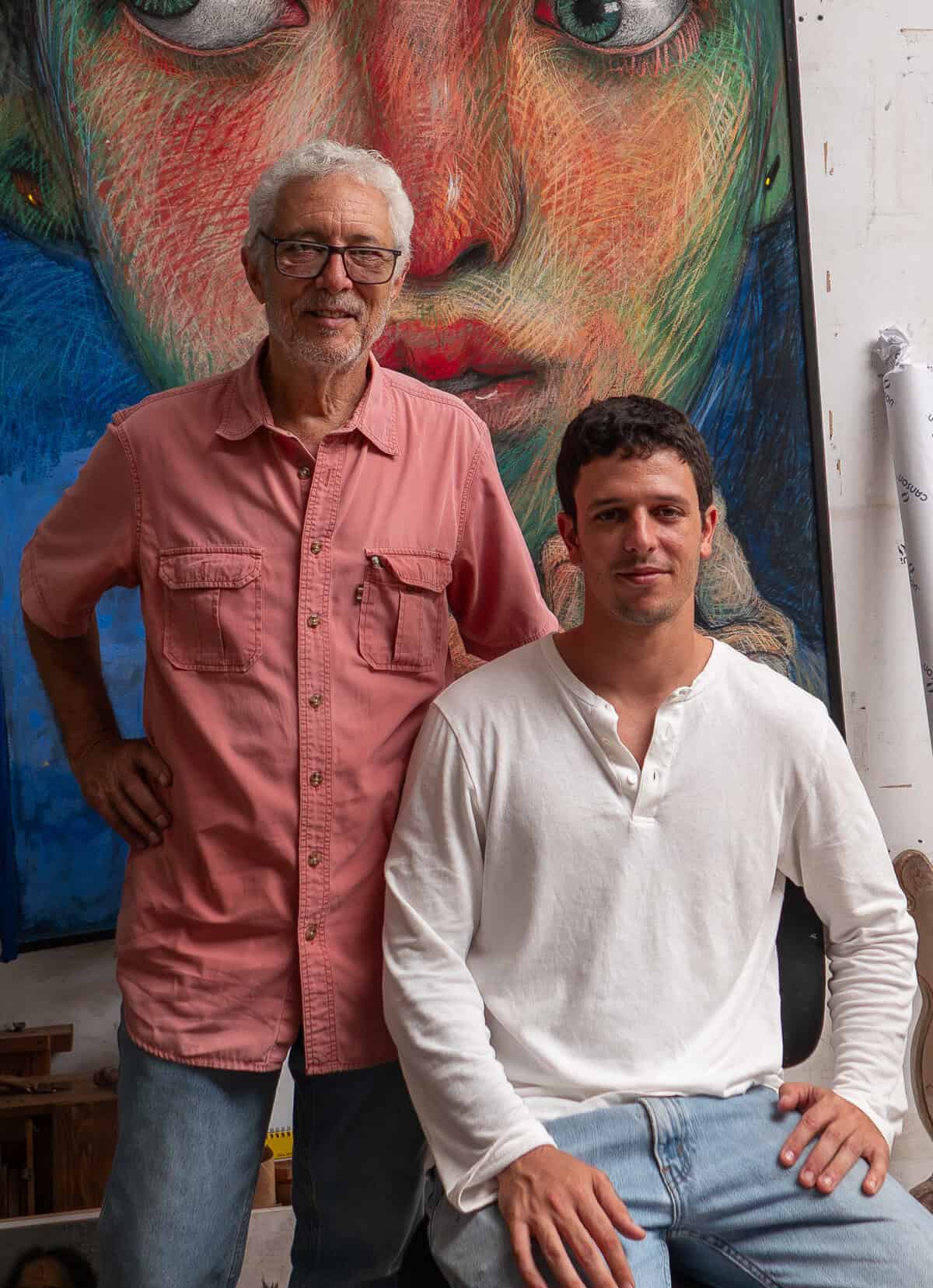
Brooke is a respected and established artist in Panama, with a body of work that extends well beyond what you see inside Olimpia. His background includes formal training in New York at the Art Students League of New York, along with decades of work across painting, sculpture, and photography. There is a discipline in his work that reflects that history, and once you are aware of it, you begin to recognize it more clearly.
What stood out to me, however, was not his résumé.
It was his position in all of this.
Olimpia is not his project. It is Paulo’s, and that distinction is not only clear, but it is also respected.
From the conversations I had, and from the time spent with both of them, there is a quiet understanding between father and son that does not need to be explained. The family owns the building, and the art naturally finds its way into the space, but there is no sense that Olimpia is being directed or shaped from above. If anything, it feels like Paulo has been given the freedom to build something entirely on his own terms, without interference or expectation.
That kind of trust is not always visible, but here, it is.
You notice it in what is not emphasized. There are no signals pointing you toward authorship, no effort to assign value, and no attempt to draw attention to individual pieces. The work is present, but it does not dominate the space. It sits comfortably within it, supporting the environment rather than defining it.
That feels intentional, even if it is never stated outright.
Brooke’s presence is there, but it is not imposed. He stands slightly to the side, observant, supportive, and, from what I could see, genuinely pleased with what Paulo has created. It is the kind of relationship where guidance exists, but ownership is never confused.
That balance is rare.
And it allows Olimpia to remain exactly what it is meant to be—a personal expression of someone who has traveled, observed, and chosen to build something that reflects his own understanding of how people want to experience a space.Not a continuation of something that came before, but something entirely his own


A Different Way of Building a Business
By the time we returned from Clayton, what stayed with me was not just the space Paulo had created, but the way he had chosen to build it.
In Casco Viejo, Panama, many new openings follow a familiar path: clear concept, defined positioning, and visibility from the start. It works, but it is predictable.
Paulo took a different approach.
He began working on Olympia in 2023, quietly using the lower level of the family building and allowing the space to evolve over time. There was no announcement, no early push for attention, and no search for validation. He simply built it, piece by piece, letting it take shape on its own terms.
That decision says a great deal. It reflects confidence, but also patience more aligned with the mindset of an artist than a traditional operator.
And when you look at Olimpia through that lens, it begins to make sense.
It is not a concept designed to meet expectations. It is a space built from experience.
Paulo spoke about his upbringing in a way that felt natural and unforced. His father is an artist, and his mother a writer, someone he described as the smartest person he knows. Growing up, he was exposed to different ways of thinking and living, and that perspective is present in how Olimpia feels today.
It shows up in the balance of the space open without being undefined, structured without being rigid.
What stood out most, however, was what he said about motivation.
He spoke about his customers and his team.
It is the kind of answer you might expect, but in this case, it felt considered. Not something repeated, but something lived. And as you may notice I have repeated it
He is not focused on scale. When asked whether Olympia could exist anywhere else, his answer was simple.
It belongs in Casco Viejo.
You could recreate the physical space, but not the experience or the context that gives it meaning.
That understanding also shapes what he wants to do next.
Above Olimpia, he has apartments that he has converted into short-term stays. Over time, he hopes to offer one of those spaces to visiting artists—a place where they can stay and work for a period without financial pressure.
It is not a commercial idea.
It is a creative one.
And it reinforces what you feel when you spend time there that Olimpia is not just a business, but a space built with intention by someone who understands that how people feel inside a place matters just as much as what is being served.
Why Olimpia Stays With You as the Coffee Shop in Casco Viejo Panama
There are plenty of places you visit once, enjoy, and move on from.
Olimpia is not one of them.
What makes it different is not any single element. It is not just the coffee, or the art, or the setting. It is the way everything comes together without feeling forced. The space holds its own rhythm, and once you settle into it, you begin to understand why people return.
You are not rushed. You are not guided through a process. You are simply allowed to be there.
That is harder to create than most people realize.
In a neighborhood like Casco Viejo, Panama, where new openings continue to appear and attention shifts quickly, the places that last are the ones that feel consistent. They do not rely on novelty. They rely on how they make people feel over time.
Olimpia does that.
It is the kind of place you walk into for a coffee and end up staying longer than planned. The kind of place you return to, not because you need to, but because it feels right when you are there.
And when you leave, it stays with you.
If you’re exploring Casco Viejo for the first time, the easiest way to understand how it all connects is to walk it properly…In your own time 👉 Start your self-guided walk here:


Fast Facts — Olimpia, Casco Viejo, Panama
- Location: Near the Flat Arch on Ave A, Casco Viejo, Panama
- Concept: Coffee shop and gallery
- Coffee: Sourced from multiple plantations, not a single brand
- Food: Light fare, including sandwiches and salads
- Setting: Indoor seating with soft furniture and a patio overlooking the water
- Art: Original works integrated into the space, presented without labels or pricing
- Atmosphere: Relaxed, unhurried, and intentionally designed for time
Q&A — Visiting Olimpia in Casco Viejo, Panama
It is both, but it does not operate like a traditional version of either. The two exist together naturally within the same space.
Yes. Alongside coffee, Olympia offers a small, well-considered selection including sandwiches, salads, empanadas, and a range of desserts.
While the savory options are solid, Olympia is best known for its desserts. They are not an afterthought. They are part of the experience and worth making time for.
It leans more toward a relaxed, light dining experience. Coffee, something simple to eat, and time to sit and take in the space.
No. The artwork is there to be experienced, not explained. You can engage with it at your own pace.
Olimpia sources coffee from different plantations, offering variety rather than focusing on a single origin or brand.
Yes. The layout and atmosphere make it ideal for spending time without feeling rushed.
Absolutely. It offers a different perspective on the neighborhood, beyond the usual cafés and restaurants.
The space is not set up as a commercial gallery. The focus is on experiencing the work rather than purchasing it.
It can, but the space is designed to remain comfortable even when occupied.
Yes. The patio area offers views toward the water and adds to the overall experience.
It is very much a place you return to.
It is the balance between coffee, art, and atmosphere, combined with a sense of authenticity that is difficult to replicate.
Closing Thoughts on this Coffee Shop in Casco Viejo, Panama
Casco Viejo has always evolved, but what is happening now feels more personal.
There is a new generation shaping the neighborhood, not by following a formula, but by creating spaces that reflect how they see the world. Olimpia is part of that movement.
It is thoughtful without being complicated. Refined without being distant. And most importantly, it feels real.
If you find yourself in Casco Viejo, Panama, it is worth taking the time to step inside, sit down, and let the space reveal itself.
You will understand it when you are there.
Thank you for taking the time to read this piece. This one meant something to me. Over the years I’ve watched people quietly shape Casco Viejo into what it is today. Behind the color of Panama, there are stories that rarely get told. This is simply my way of acknowledging them.
This is part of a broader effort to document Casco Viejo as a living community, not just a destination. When you slow it down, you begin to see the character, the resilience, and the people behind it.
If this perspective has you curious, you may enjoy exploring a Casco Viejo rooftop hotel, spending time at a boutique hotel in Casco Viejo Panama, or taking a closer look at how people choose to learn Spanish in Casco Viejo Panama.
- 🎨 Brittany Morgan — a look at creativity and expression within the Casco Viejo community
- 🌇 Casco Viejo Rooftop Hotel — the energy of the neighborhood from above
- 📍 Casco Viejo Boundaries — where the district begins and why it matters
If you’re visiting and want to experience Casco with clarity and context, I’m always happy to help you see beyond the surface.
Casco Viejo Walking Tour
Explore Casco Viejo at your own pace with a flexible self-guided walking route designed for your phone.
- No groups, no schedules
- Start anywhere, stop anywhere
- Works on phone or desktop
Panama City In 24 Hours
A carefully paced local itinerary for travelers with limited time who still want to experience Panama properly.
- Arrival day made simple
- Rooftops, dining & local rhythm
- Smart airport timing
Three Nights & Four Days
A flexible Panama itinerary centered around Casco Viejo, designed to help you arrive calmly and plan with confidence.
- Casco Viejo as your base
- Smart day trips and dining
- Timing without overplanning
Casco Peatonal: When the Streets Come Alive
Once a month the historic quarter closes to traffic and opens to people. Music, families, classic cars, and culture fill the streets in one of the most authentic celebrations in Panama.
DISCOVER CASCO PEATONALDestination Weddings in Casco Viejo
Colonial churches, rooftop sunsets, candlelit courtyards, and boutique hotels all within walking distance. Couples from around the world are discovering why Casco works beautifully.
EXPLORE WEDDINGSThe History of Casco Viejo
Founded in 1673 after pirates destroyed the original Panama City, this UNESCO World Heritage district carries centuries of stories in its churches, plazas, and narrow streets.
EXPLORE THE HISTORYJames P. Rice
James P. Rice purchased a home in Casco Viejo in 2008 and brings more than 40 years of hospitality, restaurant, tourism, and convention industry experience to CascoViejo360.com.
His background includes leadership positions with Ritz-Carlton and Hyatt Hotels, executive roles with major convention centers, and ownership of restaurants and pubs in both the United Kingdom and the United States.
Every article, hotel, restaurant, rooftop venue, attraction, and experience featured on CascoViejo360.com is selected through local knowledge, personal experience, and professional review, with careful consideration given to visitor experience, service standards, authenticity, and its contribution to the overall Casco Viejo and Panama City visitor experience.