
Panama City Walk Near Casco Viejo: Why Cinta Costera Defines the Modern City
This Panama City walk near Casco Viejo along Cinta Costera 2 reveals how the historic quarter connects seamlessly to the modern skyline.
If you spend a morning inside Casco Viejo, you feel intimacy immediately. The streets are narrow by design, shaped centuries ago for defense and devotion. Church bells echo between stone façades. Coffee drifts from open doorways. The scale feels human and contained. It slows you down naturally. That compression is why Casco Viejo is one of the most compelling historic districts in Central America. But if you are searching for the most strategic Panama City walk near Casco Viejo, you need to step beyond the old quarter and toward the open waterfront.
But here is the mistake many visitors make.
They assume that intimacy represents the whole city.
It does not.
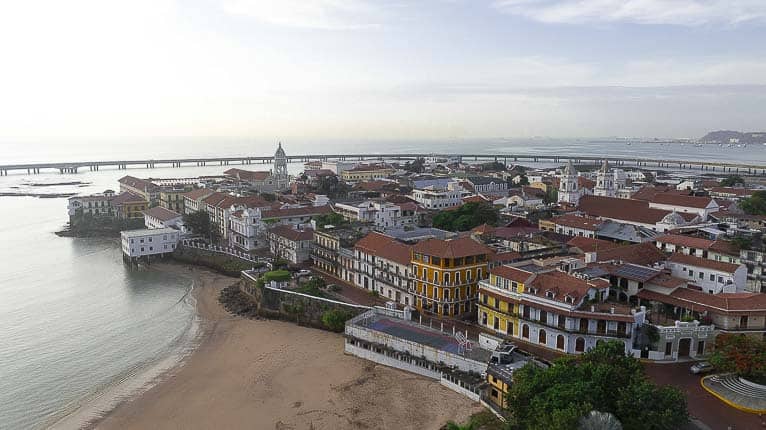
Five minutes beyond the old quarter, Panama City opens dramatically along Avenida Balboa. The skyline does not creep into view. It asserts itself. For many visitors, this route effectively becomes a self-guided Panama City walking tour, linking Casco Viejo to the modern waterfront skyline.
What most visitors forget is how close the Panama Canal sits to this skyline. The ships moving through the locks are not some distant concept — they’re part of the same working system that built this city. Standing on Cinta Costera at sunrise, you’re walking beside the Pacific edge of one of the most important trade corridors on earth.
If you are searching for the most strategic Panama City walk near Casco Viejo, Cinta Costera is where the city becomes legible. This is not ornamental landscaping built for photographs. It is engineered waterfront infrastructure designed for daily life. Walking it gives you immediate spatial clarity. Distances become measurable. Districts connect logically. You stop feeling like a visitor navigating fragments.
I have lived in Casco Viejo since 2008. My professional life has been Hotels, Catering, and Convention Services. Orientation determines how guests experience a city. When geography becomes clear, anxiety drops. When anxiety drops, exploration expands. Cinta Costera 2 delivers that orientation faster than any tour.
Understanding the Scale: Why This Panama City Walk Near Casco Viejo Matters
Travelers often search for attractions. What they truly need is perspective.
Cinta Costera provides perspective.
The corridor begins near the Mercado de Mariscos and stretches toward Punta Paitilla. It is distinct from the Casco wraparound extension. This is the central waterfront spine of modern Panama City. It was engineered as infrastructure first and recreation second. The pedestrian lane is wide and forgiving. The cycling lane is clearly separated. Lawns are manicured deliberately. Drainage systems manage tropical downpours efficiently.
This is not decorative urbanism.
It is disciplined civic planning.
One direction measures approximately five kilometers. Walking out and back gives you nearly ten. You can turn around at any pedestrian bridge without losing structure. That flexibility removes psychological pressure. Visitors walk further because they know they are not committed.That design intelligence is precisely why this is the strongest Panama City walk near Casco Viejo


The Urban Backstory: Reclaiming the Waterfront
Before Cinta Costera, Avenida Balboa was dominated by traffic and fragmentation. The city had grown vertically but not publicly. Waterfront access was inconsistent. Pedestrians competed with vehicles.
The Cinta Costera project rebalanced that equation.
Land was reclaimed from the Pacific. Traffic lanes were reorganized. A continuous pedestrian corridor was introduced. Public space was reclaimed as a civic priority. Cinta Costera 2 expanded that corridor further east, connecting Casco Viejo to the residential and hotel district of Punta Paitilla.
This matters because it signals intention.
Cities that invest in continuous public corridors invest in quality of life. Quality of life attracts residents. Residents create authenticity. Authenticity strengthens visitor experience.
That chain reaction is visible here every morning.
The 6:45 AM Start for This Panama City Walk Near Casco Viejo
If you want to experience this properly, begin at 6:45 AM.
The air is manageable. The humidity has not fully settled. The sunrise light softens the skyline before sharpening it. You blend into community rhythm instead of observing it from distance.
Serious cyclists move in coordinated packs. Many ride carbon frames that cost as much as small cars. Runners pace in disciplined pairs. Rollerbladers glide smoothly along the surface. Parents push strollers. Retirees walk with consistency.
You are not interrupting anything.
You are joining it.
The large Panamanian flag becomes a focal point against the rising light. The bay reflects color gradually. Casco Viejo rests behind you in silhouette. The skyline ahead grows brighter with each minute.
This is not staged beauty.
It is lived modernity.


The Amphitheater Transition into Why This Panama City Walk Near Casco Viejo
Leaving Casco Viejo through the amphitheater zone marks a clear shift in scale.
The streets widen. The skyline emerges. The compression of the old quarter releases into open waterfront. You move from stone corridors to civic stage.
The amphitheater itself feels flexible by design. On a quiet morning, it reads as open space with potential. But that potential is real. This area comes alive throughout the year. It hosts announcements and public presentations. It anchors Pride celebrations. It supports Chinese cultural events. On the fourth Sunday of each month, pedestrian activations spill naturally through this space.
The amphitheater leads directly toward the newly inaugurated beach. That proximity changes how the space functions. It is not static seating. It is transitional terrain between heritage and modern waterfront. On some mornings, you may find yoga sessions unfolding against the bay.
Within minutes, the corridor absorbs you.
Walk toward the large national flag. Pause. Turn back toward Casco Viejo. The historic peninsula appears contained and intentional. Avenida Balboa’s high-rise communities frame the opposite side. The Pacific stretches wide and confident.
In that single pivot, you understand the relationship between old and new.
That clarity is the point.


The Cycling Culture: Where Business and Performance Intersect
The separated cycling lane is not decorative. It is essential.
Serious cyclists choose their training corridors carefully. They need predictable surface, clear separation, and uninterrupted distance. Cinta Costera 2 delivers all three consistently.
Early in the morning, you will notice groups riding in uniform. Coordinated kits. Aerodynamic helmets. Precision pacing. Many of those bikes cost between five and fifteen thousand dollars. They are not casual purchases. They are performance tools.
Now and again, you will see a solo rider pushing hard against the wind. From a distance, it looks simple. A man riding a bicycle along the bay. But watch closely. He is likely a triathlete training seriously. Panama has a strong endurance culture. Many are preparing for regional or international competitions.
The interesting thing about Panama is this.
We are not a massive golf culture. Deals are not typically closed on the eighteenth green. Here, business often happens differently. It happens over a morning ride. Or later over lunch at The Market Restaurant in Panama City. That balance between athletic discipline and professional ambition defines much of the capital’s energy.
At the same time, families ride comfortably at slower pace. Parents guide children along the protected lane. Casual riders share the same infrastructure as competitive athletes without friction.
That coexistence tells you something important.
This corridor supports performance and participation simultaneously.
That balance is not accidental.
It is engineered.


The Outdoorsy Feel of a Financial Capital
Panama City is a financial hub. It is dense. It is vertical. Yet along Cinta Costera, it feels open and breathable.
Manicured lawns soften the skyline. Benches allow pause. Play areas give children room to move. The Pacific breeze remains constant. The wide walkway reduces congestion even during peak hours.
You feel active without pressure.
You feel urban without confinement.
This combination is why this Panama City walk near Casco Viejo resonates strongly with visitors.
The Orange Juice Stand Evolution
Years ago, one stand began with a few bags of oranges and modest setup. Over time, it grew into an iconic morning stop. Cyclists finish sessions and line up briefly. Runners hydrate quickly. The stand expanded because demand remained consistent.
This organic growth tells a story.
The corridor is not dependent on tourism cycles. It is supported by daily community life. Visitors stepping into that rhythm feel authenticity immediately.
I often stop here for a quick juice before turning back toward Casco. After fifteen years living in Panama, it’s one of those small rituals that never loses its appeal. Fresh orange juice, ocean air, and the skyline waking up in front of you it’s a simple moment, but it captures the rhythm of the city perfectly.


The Beach Soccer Court: Urban Sport as Culture
The enclosed beach soccer court is one of the corridor’s most revealing features.
This is not random sand. It is purpose-built and engineered. Fencing protects pedestrian flow. The foundation beneath the surface was layered carefully for professional-grade play.
For several weeks, I rode past the construction site without knowing what they were building. The scale surprised me. I assumed it was another tennis or paddle court.
It was not.
They were building a beach soccer facility.
Soccer in Panama has grown dramatically over the past decade. My son played professionally for Chorrillo FC from 2010 to 2015. Today, Panama has qualified for the World Cup Finals for the second time. For a country of fewer than four million people, that achievement matters.
In the morning, you see disciplined training sessions begin early. Return in the evening and five-a-side courts across the city are full. Teams rotate constantly. Participation is serious and consistent.
Beach soccer here is not a novelty for visitors.
It reflects a culture that prioritizes movement, community, and competition.
And as you walk past, something becomes clear.
Panama works hard, but it works to live. It does not live to work.
You are not walking through a tourist district.
You are walking through a capital city that invests in how its people live.


Paddle Tennis: The Sound of Routine
The paddle tennis courts add a distinct rhythm to the corridor.
The sharp pop of ball contact carries lightly across the waterfront. Players arrive prepared. Matches begin early. Many participants come before work. The consistency tells you this is routine, not performance.
Like many cities around the world, Panama has embraced the paddle tennis trend. The sport has taken off globally. In some countries, courts are fully booked weeks in advance. Here, the culture feels different. It is enthusiastic but not frantic.
Most mornings, you can walk down to the paddle courts and find space. If you are friendly, you will likely be able to pair up with someone. The atmosphere is competitive yet welcoming. It feels inclusive rather than exclusive.
That accessibility matters.
As you walk along Cinta Costera, you begin to notice something subtle. This corridor was not built for tourism brochures. It was built for the culture and the community of Panama. It was designed for residents of all lifestyles to enjoy the country in which they live.
Families walk. Athletes train. Retirees move steadily. Vendors work. Grounds crews maintain. Paddle players compete. Cyclists pace. Everyone shares the same engineered waterfront.
We simply share it with our visiting friends.
Urban authenticity often reveals itself through morning routines. Paddle tennis at sunrise signals civic confidence. People commit to structured sport because the space supports it reliably.
That reliability reflects the broader engineering of Cinta Costera.
It was built for living first.
Tourists benefit second.
And that is exactly why it works.
A Quick Pause: The Bird on the Crest
About a third of the way down Cinta Costera, your stride settles. Casco is behind you. The skyline feels less dramatic and more normal. You’ve seen families, runners, and fishermen working the edge of the bay. This is usually where I slow people down for a moment.
Panama’s national bird is the Harpy Eagle — the one you see on the country’s coat of arms. Not a logo. Not branding. A real rainforest predator. Powerful. Protective. Territorial.
You won’t see it flying here. It lives deep in the jungle. But symbolically, it sits above the nation’s crest holding the words Pro Mundi Beneficio — “For the Benefit of the World.”
That line explains Panama better than most brochures ever could.
A small country. A global crossroads. Always connecting something bigger than itself.
And then the walk shifts again — toward paddle courts, beach soccer, and the energy of daily life.


Hotel Proximity: Built Into the Stay. The Panama City walk near Casco Viejo
From Hilton Panama, you step directly onto the corridor. From the Miramar InterContinental, you are seconds away. The Marriott Executive Apartments sit just behind the waterfront. The Waldorf Astoria, Bristol Panama, W Panama, and Le Méridien are all within close walking distance. Even extended-stay and business properties along Avenida Balboa connect easily through pedestrian bridges.
Residential towers line the stretch between these hotels, creating a continuous urban edge. Guests do not need transportation. They do not need planning. They simply step outside and join the rhythm.
That accessibility removes excuses.
As someone who has operated hotels for decades, I understand this clearly. When something is effortless, guests participate. When they participate, satisfaction increases. When satisfaction increases, memory strengthens.
Cinta Costera is not an excursion.
It is integrated into the stay.


Infrastructure and Safety Along This Panama City Walk Near Casco Viejo
Cinta Costera was engineered for flow, visibility, and confidence.
Pedestrian bridges cross Avenida Balboa at regular intervals. If you decide to shorten the route, you can pivot easily. Uber operates consistently along the corridor. Exit options remain obvious and accessible.
That visibility matters.
This section refers specifically to Cinta Costera, not Cinta Costera 2 or 3. The extension around Casco continues to evolve, and development phases differ. When walking for exercise and sunrise rhythm, Cinta Costera is the established and structured corridor.
It is also consistently patrolled.
More importantly, it is consistently used.
Safety here does not feel forced. It feels communal. Grounds crews maintain lawns early. Cyclists train seriously. Families walk with children. Vendors set up refreshment stands. Pride in the space is visible. When a corridor is used daily by all lifestyles, it becomes self-regulating.
Confidence changes behavior.
Visitors walk further when they feel secure. They pause for photographs. They sit on benches without hesitation. They blend into the rhythm rather than scanning constantly.
This is not accidental.
It is the result of thoughtful infrastructure combined with civic pride.
And that elevates the entire experience.
Extended Fast Facts: Panama City Walk Near Casco Viejo
- Primary Corridor: Cinta Costera
- Location: Avenida Balboa waterfront
- Distance One Way: Approx. 5 km
- Round Trip: Approx. 10 km
- Best Start Time: 6:45 AM
- Surface: Flat, paved, engineered
- Sport Facilities: Beach soccer, paddle tennis, cycling lanes
- Landmarks: Large Panamanian flag, Hilton Panama
- Access Points: Casco Viejo amphitheater descent, multiple bridges
- Exit Strategy: Uber readily available
Frequently Asked Questions About Walking Cinta Costera 2
Yes. It provides immediate geographic clarity.
No. It is flat and flexible.
Strongly recommended for light and temperature.
Often active in the evenings after work, especially weekdays.
Yes, with structured access.
Yes. Wide, even pavement supports families.
Yes. The distance supports tempo sessions.
Early mornings reduce discomfort significantly.
Limited shade, so early start helps
Yes, with standard urban awareness.
Absolutely. Walk first, then enjoy coffee.
Yes, It is also one of the reasons we created the Casco Viejo Self-Guided Walking Tour. Visitors often want structure without restriction. They want insight without being herded. A well-designed self-guided format allows you to explore confidently while still understanding what you are seeing.
Why This Walk Defines the Modern City
Cinta Costera compresses multiple narratives into one corridor.
Historic preservation sits behind you. Financial ambition rises beside you. The Pacific anchors your right. Sport and community unfold around you. Hotels integrate seamlessly. Infrastructure supports everything quietly.
But the deeper value of this walk is not only urban design.
It is perspective.
Whether this is your first morning in Panama, your second day settling in, or your final afternoon before flying home, this corridor recalibrates how you see the country. Even if you have spent days in Boquete, Bocas del Toro, Pedasí, or the Canal Zone, walking Cinta Costera 2 reconnects everything back to the capital.
As you move along the path, you encounter the full spectrum of the Republic of Panama. You see municipal crews cutting grass and manicuring flowers with discipline. You pass vendors selling fresh juice and small snacks to early athletes. You look up at the high-rise buildings and begin to understand the diversity inside them. Luxury apartments. International residents. Local families. Corporate offices. Global hotel brands. Different communities stacked vertically within one skyline.
What Surprises Visitors About Panama City
Many visitors arrive with outdated perceptions. They come expecting something less developed. They use words like “Third World” without understanding modern Panama. Then they walk this corridor at sunrise and stop in their tracks.
“I had no idea the skyline looked like this.”
That moment happens often.
The scale surprises people. The order surprises people. The safety surprises people. The fact that you can walk comfortably at 6:45 AM alongside families, professionals, retirees, and serious athletes changes assumptions quickly.
You are not consuming an attraction.
You are participating in a functioning system.
And sometimes, as you walk further, another thought creeps in quietly.
“This could be a place I would want to live.”
That thought is more common than most people admit. I have heard it countless times. I had it myself many years ago. Panama has a way of shifting your internal compass. It introduces gratitude. It introduces balance. It shows you a country that is forward-looking yet grounded, modern yet human.
For anyone searching online for the best Panama City walk near Casco Viejo, this is not simply a route recommendation. It is an orientation strategy. It is a confidence builder. It is a lifestyle lens into the country we call home.
Walk it at 6:45 AM and blend into the rhythm of the city as it wakes. Watch beach soccer training begin. Hear paddle tennis echo across the bay. Observe cyclists moving with purpose along the separated lane. Take a moment to look back at Casco Viejo with the skyline fully understood. As you return for breakfast, you will feel something different oriented, comfortable, and pleasantly surprised.
Thanks for reading. I genuinely appreciate you taking a few minutes to understand how a simple walk from Casco Viejo into Panama City can reveal so much more than a skyline. When you step onto Cinta Costera 2, you’re not just stretching your legs — you’re seeing how we live.
In one corridor, you encounter manicured gardens, cyclists training seriously, paddle tennis before work, beach soccer at sunrise, vendors setting up, and high-rise residences looking over the Pacific. It’s a snapshot of the Republic of Panama in motion. Old quarter behind you. Financial district beside you. Community all around you.
If this is your first, second, or even last day in Panama, this walk helps you understand the rhythm of the country quickly and confidently. And if you’d like to go deeper into Casco itself, these pages will help you stay oriented:
- 🗺️ Casco Viejo Self-Guided Walking Tour — a structured way to understand the history, architecture, and layout before or after your waterfront walk.
- 📍 Casco Viejo Boundaries — so you clearly understand where historic Casco ends and modern Panama City begins.
- ⛪ Metropolitan Cathedral of Casco Viejo — the architectural and cultural anchor of the district before you transition toward the open waterfront.
Want to experience Panama City properly? Start in Casco Viejo, step onto Cinta Costera 2, and let the walk teach you. In under ninety minutes, you’ll understand the culture, the ambition, the safety, and the lifestyle that define modern Panama.
Three Nights & Four Days
In Panama — Done Properly
A flexible Panama itinerary centered around Casco Viejo, designed to help you arrive calmly, explore intelligently, and make the most of a short stay without overplanning every hour.
- Arrival day made simple
- Casco Viejo as your base
- Smart day trips, dining, and timing
Explore Casco Viejo
On Your Own Time
This self guided walking tour is designed to last up to four hours, but you set the pace. Do it in one relaxed half day, or break it into a few stops between coffee, meals, and photos.
- No groups, no schedules
- Start anywhere, stop anywhere
- Works on phone or desktop
Where to Stay in Casco Viejo
Not every hotel fits every traveler. This curated guide breaks down the top properties by atmosphere, location, design, and who they’re truly right for.
SEE THE BEST HOTELSThe Top Six Restaurants in Casco Viejo
If you only have a few nights, these are the tables that matter. Thoughtfully selected, personally experienced, and chosen for food, setting, and consistency.
VIEW THE TOP SIXOut & About with James
Walk the streets through local eyes. Stories, cultural insights, new openings, quiet corners, and the evolving rhythm of Casco Viejo — week by week.
READ THE LATEST BLOGSJames P. Rice
James P. Rice purchased a home in Casco Viejo in 2008 and brings more than 40 years of hospitality, restaurant, tourism, and convention industry experience to CascoViejo360.com.
His background includes leadership positions with Ritz-Carlton and Hyatt Hotels, executive roles with major convention centers, and ownership of restaurants and pubs in both the United Kingdom and the United States.
Every article, hotel, restaurant, rooftop venue, attraction, and experience featured on CascoViejo360.com is selected through local knowledge, personal experience, and professional review, with careful consideration given to visitor experience, service standards, authenticity, and its contribution to the overall Casco Viejo and Panama City visitor experience.