How to Travel Around Panama, the Smart Way
How to travel around Panama Complete Transportation Guide for Airports, Flights, Buses, Baggage, and Real-World Logistics
If you’re searching for how to travel around Panama, what you’re really asking is this:
Is it easy?
Is it reliable?
Will I get stuck?
Am I overthinking this?
The short answer: Panama is easy if you understand its rhythm. Before we go any further, let me set expectations.
This is not one of my romantic, storytelling pieces about rooftop sunsets or slow mornings in Casco Viejo. This is the blog you read before you book flights, before you stack island transfers, before you connect a domestic flight to an international departure.
Vacations are built on movement. Airports. Transfers. Baggage. Timing. Weather. Human decisions.
There are more moving parts in a well-planned annual vacation than most people realize. And when you start layering regional travel islands, mountains, domestic flights, ferries, those moving parts multiply.
You could consider reading this “work.” And frankly, you should.
For the amount of time, money, and anticipation you invest in your annual vacation, you owe it to yourself to understand how transportation actually works here. Read this once, properly. Absorb it. After that, it becomes simple.
Panama is not complicated. But it does not reward improvisation on tight timelines.
This is a country with three commercial airports serving Panama City, a functioning metro system, national bus routes, domestic aviation, ferries, private charters, ride-share platforms, executive drivers, and growing infrastructure. On paper, it’s straightforward.
In practice, what confuses visitors is not a lack of access. It’s sequencing.
Every week, I see the same questions online
- Can I Uber from the airport?
- What’s the difference between Tocumen and Albrook?
- Is Panamá Pacífico a real airport?
- What happens if my Bocas flight is delayed?
- Do I need a car?
- Are buses comfortable?
- How much baggage can I take on domestic flights?
The repetition tells you something important: the system works — but you need to understand how to use it.
If you take one principle from this entire Panama transportation guide, let it be this:
Build margin into regional travel
Not because Panama is unreliable. It isn’t. But because of tropical weather, domestic baggage weight limits, traffic timing, bridge crossings, and human scheduling all matter here.
And let me say this clearly:
Do not try to outsmart how transportation runs in Panama.
There is nothing worse than spending the final 48 hours of your vacation with your fingers crossed because you have tight connections. That quiet anxiety ruins what should be a relaxed farewell.
Vacations should end well.
Not with stress. Not with tension. Not with contingency plans unfolding in real time.
When you plan with breathing room, traveling around Panama becomes smooth. When you compress your itinerary tightly, you create your own friction.
Let’s break this down properly.
How to Travel Around Panama Without Creating Stress
When people search for how to travel around Panama, they aren’t just asking about buses and flights. They’re asking how to move efficiently without losing time, money, or patience.
The answer is structure.
- Choose a base.
- Understand the airport geography.
- Avoid tight domestic-to-international connections.
- Pack lighter than you think.
- Select transport based on distance, not impulse.
That is the best way to travel in Panama.
Choose a Base Before You Choose Transport & How to travel around Panama
The single biggest mistake visitors make when planning how to travel around Panama is over-movement.
Panama is geographically narrow but experientially diverse, with colonial neighborhoods, Pacific islands, Caribbean coastlines, mountain towns, jungle rivers, and skyline districts. On a map, it looks compact. In reality, each region operates at a different rhythm.
The temptation is to change hotels every night.
Resist it.
The smartest way to travel around Panama is to establish a base, acclimate, and then branch outward.
If you are starting in Panama City, your neighborhood choice matters more than most people realize.
Casco Viejo: The Intelligent Acclimation Point
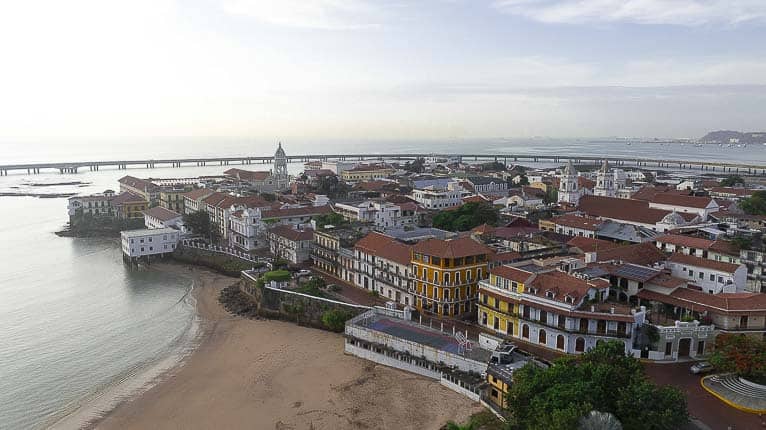
Casco Viejo is not simply a charming district. It is a UNESCO World Heritage Site — officially recognized for its historic and architectural significance. But more importantly for travelers, it is human in scale.
Walkable streets. Cafés. Rooftop views. Museums. Small plazas. Waterfront promenades. Local artisans. Boutique hotels.
If you have just landed in Panama especially after a long international flight Casco Viejo allows you to slow down without isolating yourself. You can move on foot. You can understand the culture visually. You can recalibrate to the climate. You can sit outside and observe.
For travelers planning multi-region itineraries Boquete, Bocas del Toro, the Pearl Islands, and El Valle — Casco functions as a grounding point. It lets you adjust before layering on domestic flights, ferry schedules, or regional transfers.
It is also strategically located. From Casco, you are within a manageable distance of:
- Tocumen International Airport
- Albrook (domestic airport)
- Panamá Pacífico International Airport
- The Amador Ports
- The national bus terminal
- Major road arteries
You are in the city — but not swallowed by it.
That combination makes Casco Viejo one of the smartest home bases for travelers who want both character and logistical flexibility.
Punta Pacífica and Costa del Este: Modern Urban Comfort
If you prefer high-rise living, branded residences, and modern skyline energy, Punta Pacífica and Costa del Este offer polished urban comfort.
These neighborhoods appeal to travelers who value contemporary infrastructure and proximity to major shopping centers and business districts. For longer stays or loyalty-driven hotel guests, they provide familiarity and predictability.
Marbella and Obarrio: Central Access and Hotel Concentration
Marbella and Obarrio sit closer to Panama City’s business core and branded hotel district. For corporate travelers, conference attendees, or loyalty-program guests, this area offers central access and established international hotel options.
Wherever you choose, the principle remains the same: Anchor yourself. Then branch outward. Panama works best in chapters, not in frantic edits.
Spending three or four nights in one intelligent base before transitioning to another region makes getting around Panama dramatically smoother. It allows you to understand traffic timing, climate rhythm, and airport geography before stacking connections.
If you’ve read my piece on the Best 3-Day Getaways From Casco Viejo, you already understand this philosophy. Travel in Panama is not about speed. It is about sequence
Panama City’s Three Airports — Know the Difference and How to travel around Panama
Most travelers assume Panama City has one airport. It has three.
Understanding their roles eliminates half of the confusion around getting around Panama.
Tocumen International Airport (PTY)
This is Panama’s primary international gateway — and it has transformed dramatically over the past fifteen years.
I have been flying in and out of Tocumen since 2008, when it still felt like a small regional airport. Back then, after the last flight of the night, the lights quite literally went off. Operations slowed. It felt modest.
Today, it is something entirely different.
Tocumen is now one of the strongest aviation hubs in the Americas. Copa Airlines operates its “Hub of the Americas” from here, connecting North, Central, and South America with remarkable efficiency. The airport runs continuously, professionally, and at scale.
There are now two terminals, and this matters for departures.
Terminal 2 is the newer, state-of-the-art facility — modern, spacious, and purpose-built for international operations. It is, quite frankly, better than many airports you may have passed through in the last decade. High ceilings, clean lines, automated systems, and efficient passenger flow.
Terminal 1 remains active as well, so when departing, confirm your terminal. Your Uber driver will know the difference, but it’s always wise to double-check your airline and terminal before heading out.
Arrivals at PTY: What to Expect
Arriving at Tocumen is straightforward.
Immigration is automated and efficient. There is no longer paperwork to complete for most travelers. You proceed through passport control, collect your luggage, clear customs, and move directly to curbside pickup.
The flow is linear and logical.
If you are being met by a private driver, car service, or tour operator, they will typically meet you just beyond baggage claim. If you are using Uber, the pickup area is clearly marked, and wait times are generally short — often less than five minutes.
Airport Wi-Fi is available immediately upon arrival, which makes coordinating transportation easy even if you have not activated local data yet.
For larger families or groups, van services operate from the airport and can be arranged in advance. The infrastructure supports both independent travelers and organized groups comfortably.
And importantly, the airport is located approximately 25 minutes from central Panama City under normal traffic conditions.
Departing from PTY: Calm, Not Chaos
One of the misconceptions visitors sometimes have is that departing from Tocumen will feel chaotic or outdated.
It does not.
This is a major regional hub. Passenger flow is steady but controlled. It does not resemble an overwhelmed airport during peak hours in cities like Los Angeles or Dallas.
Arriving two hours before an international flight is generally sufficient. Bags must be checked, and passengers must be checked in at least one hour before departure, but there is no need to arrive excessively early.
Security lines move consistently. Immigration is structured. Signage is clear.
Terminal 2 in particular offers a modern departure experience, including airline lounges, club access areas, and well-designed waiting spaces.
Shopping is strong for a regional hub. While you won’t find every global luxury brand, you will find quality gift options Panamanian coffee, rum, chocolate, Panama hats, and other locally relevant products.
It feels like an airport that understands its role: a serious connector between continents.
And if you remember what it looked like fifteen years ago, the transformation is remarkable.
Marcos A. Gelabert Airport (PAC / Albrook)
Located next to Albrook Mall and the national bus terminal, Marcos A. Gelabert Airport — commonly referred to simply as “Albrook” — handles the majority of domestic flights within Panama.
If you are flying to:
- Bocas del Toro
- David (gateway to Boquete)
- Pedasí
- Other internal destinations
You will almost certainly depart from here.
Albrook is not a grand international terminal. It is compact, efficient, and unapologetically practical.
Think one-story building. Curbside drop-off. Short counters. Minimal walking distance. No long corridors. No escalator maze.
You pull up, check in, pass through security, and you’re at your gate within minutes.
For first-time visitors, the setting can feel surprising almost industrial at first glance. This airport has been operating for decades. It doesn’t try to impress. It tries to function.
And it does.
The staff is experienced. Processes are straightforward. Everyone who works here understands that domestic travel in Panama is frequent and routine. The pace is calm. Efficient. Slightly laid-back but rarely chaotic.
Most domestic departures tend to operate earlier in the day. Morning flights are common, particularly for routes like Bocas del Toro or David. If you are flying internally, treat it professionally: arrive on time, bring your passport, and have any required documents ready. Even though it is a domestic flight, identification is required and occasionally checked carefully.
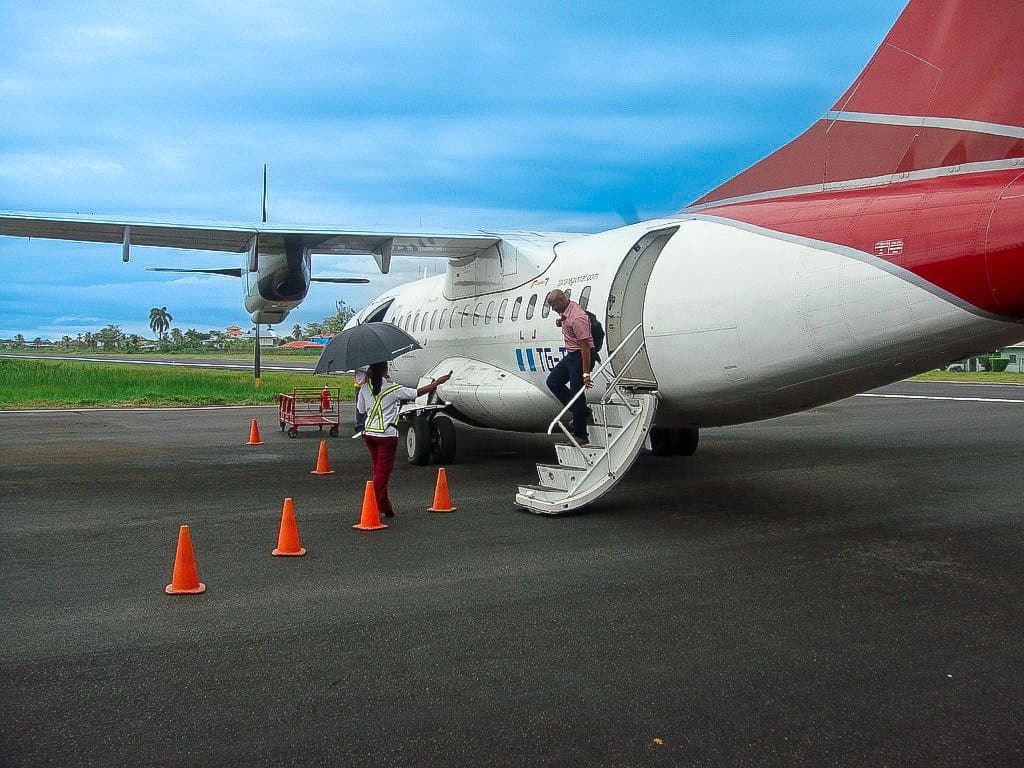
One important detail: there are no jetways.
You will walk across the tarmac and board via stairs. If you are used to enclosed airport bridges, this will feel different. It is not uncomfortable but it is direct. You are boarding a small aircraft in a working aviation environment.
For many travelers, this is where the adventure begins.
There is something refreshingly honest about Albrook. You are not navigating luxury lounges or long retail corridors. You are stepping into regional aviation small aircraft, short runways, fast climbs over jungle or coastline.
It is efficient. It is uncomplicated. And it moves quickly.
What Albrook lacks in architectural polish, it makes up for in speed and clarity. From curbside to aircraft seat can take less time than it takes to find your gate at larger international hubs.
If you understand what it is a functional domestic airport built for movement rather than spectacle it becomes one of the easiest parts of traveling around Panama.
Panamá Pacífico International Airport (BLB)
This is the third airport many travelers overlook — and it matters.
Located on the west side of the Panama Canal, Panamá Pacífico (BLB) handles select regional and low-cost international flights. Airlines such as Wingo operate routes between BLB and Colombian cities, including Bogotá and Medellín, making it a practical alternative to Tocumen for certain regional connections.
If your ticket says BLB instead of PTY, do not panic. It is a fully operational commercial airport simply smaller and geographically different.
However, there are two realities you need to understand.
First, access timing matters. Panamá Pacífico sits west of the Canal, which means traffic patterns can significantly affect transfer time. The most challenging window is typically between 3:30 PM and 8:00 PM, when residents are leaving the city and crossing bridges to return home. During that period, what looks like a simple drive on the map can take considerably longer. If you are departing from BLB in the late afternoon or early evening, give yourself generous travel time.
Second, remember that this airport serves low-cost carriers.
Think Ryanair logic.
Budget airlines price tickets attractively but monetize the details. That means:
- Seat selection often costs extra
- Checked baggage is charged separately
- Carry-on weight limits are enforced
- Priority boarding is additional
- Even simple onboard items like water are typically purchased
This is not a criticism — it is simply the model.
If you understand that a budget airline means à la carte pricing, you avoid surprises at check-in. Read your baggage allowance carefully, weigh your luggage in advance if possible, and assume that extras are not included in the base fare.
Handled properly, Panamá Pacífico is a very useful airport. Misunderstood, it can feel inconvenient.
Like most transportation in Panama, the difference is in preparation.
How to travel around Panama, Airport Transfers: Real-World Timing
On a map, PTY, PAC, and BLB appear close.
In real life, traffic timing changes everything.
Can you transfer from Tocumen to Albrook the same day? Yes.
Should you plan it tightly at 4:30 p.m.? Absolutely not.
Panama City traffic shifts dramatically during peak hours. If you arrive internationally and need to fly domestically the same day, the calmest strategy is often to overnight in the city.
The metro connects Tocumen to the city. With transfers, you can reach Albrook. During light daytime travel, it works.
After a long-haul international flight with luggage, Uber is usually simpler.
This is not pessimism. It’s sequencing.
Domestic Flights: Efficient, But Weight Matters in How to travel around Panama
Domestic aviation in Panama works well, but it operates under small-aircraft logic.
One detail that surprises visitors: baggage allowances are weight-based.
When flying from Albrook on domestic carriers, baggage limits are lower than those of major international airlines. Excess baggage fees apply based on total weight if they let you check the bag as it is all about weight.
Small aircraft require careful load balancing. The rules are enforced.
If you are flying to Bocas del Toro or David, check baggage limits before arriving at the airport.
This ties directly into smart packing.
Island & Indigenous Territory Travel: San Blas (Guna Yala) and Contadora
Panama’s most beautiful escapes require a little more intention.
And that is not a warning it’s part of the charm.
San Blas (Guna Yala)
If you are traveling to San Blas, understand that you are entering Guna territory, governed by the Guna Nation.
This is not simply a beach excursion. It is autonomous indigenous land.
Here’s what that means in practical terms:
- Early morning hotel pickup (usually 5:00–6:00 AM)
- 4×4 transport into the territory
- Passport required at the checkpoint
- Entry fee paid in cash
- Boat transfer from the port to the islands
You can:
- Visit for the day
- Stay overnight in rustic island lodges
- Or fly in via small aircraft and return the same day
Flights depart from Albrook (PAC) and take approximately 40 minutes.
The system is well organized, but it runs on local rhythm. This is not a resort shuttle system. It is community-based governance.
Bring:
- Your passport
- Cash
- Light luggage
- Patience
And you will be rewarded with some of the clearest water in the Caribbean.
Ferry & Flights to Contadora Island (Pearl Islands)
Contadora is different.
This is not indigenous territory. It is part of the Pearl Islands archipelago and operates more conventionally.
You have two options:
1. Ferry from Panama City
- Departs from the Amador Causeway
- Roughly 2 hours each way
- Seas can be choppy during certain seasons
2. Domestic Flight
- 25–30 minutes from Albrook
- Weight limits apply
For short stays or weekend escapes, flying often makes more sense.
Important: Always Travel with Your Passport
In Panama, you should carry your passport at all times.
There are:
- Police checkpoints on highways
- Checkpoints entering indigenous territories
- Occasional ID checks
This is not aggressive enforcement it is normal procedure.
You will hear a photocopy is sometimes accepted.
No take the original.
If you are traveling outside Panama City, especially toward:
- Guna Yala
- Interior provinces
- Remote beaches
Have your passport accessible.
Packing for Panama: Travel Lighter Than You Think
Panama’s climate is consistent.
Yes, we have a rainy season. Yes, we get heavy downpours. But rain here is often heavy and short-lived. Temperatures remain warm year-round.
You do not need multiple wardrobes.
Bring:
- Breathable clothing
- Comfortable walking shoes
- One proper outfit for a celebratory dinner
That’s it.
You will rarely see the same people repeatedly unless you’re at a resort.
And Panama has excellent shopping from luxury brands in modern malls to boutique finds in Casco Viejo. Many travelers buy something here anyway.
Pack smart. Reduce baggage stress. Make domestic flights easier.
Buses in Panama: National Reach, Scale, and How to travel around Panama
Albrook Bus Terminal is the heart of Panama’s national ground transportation system and it surprises people.
If you have the opportunity to visit the terminal itself, you’ll understand immediately. The scale is impressive. Multiple platforms. A constant rhythm of departures. An assortment of buses heading in every direction across the country.
From here, buses run daily to:
- David (gateway to Boquete)
- Santiago
- Chitré
- Las Tablas
- Beach corridors
- And numerous regional destinations
Short-distance routes typically two to five hours generally operate throughout the daytime. Long-distance buses often run overnight, particularly for cross-country travel.
But here’s where travelers need to pay attention.
Two buses can be heading to the same destination and offer completely different experiences.
One may make multiple stops along the way. Another may run more directly. One may be what locals casually call a “refrigerator bus” very strong air conditioning, simple seating, basic format. Bring a light sweater or cardigan; you will thank yourself later.
Another may be a full-size coach reclining seats, more spacious layout, sometimes comparable to European long-distance buses.
You need to do a small amount of homework before boarding, so expectations align with reality. Check the operator. Confirm departure times. Understand if it’s a direct route or a stopping service.
That small effort prevents disappointment.
Beach Routes and the “Side of the Road” Drop-Off
When traveling to beach destinations, especially along the Pacific corridor, buses often drop passengers along the main highway rather than at the final accommodation.
For North American travelers, this can feel disorienting at first you step off the bus, and you’re roadside.
Rest assured: this is normal.
Local taxis know the bus schedules. They know when passengers arrive. It’s second nature. You are not stranded; you are entering the local rhythm.
Within minutes, you’ll be moving toward your hotel, hostel, or rental property.
Reliability and Weather Reality
Interestingly, buses are sometimes more reliable than domestic flights particularly during weather disruptions.
If inclement weather prevents small aircraft from operating on a given day, airlines typically adjust schedules and increase frequency the following day. Flights in Panama are often short roughly an hour so moving people forward quickly is manageable.
No one is abandoned. But schedules can shift.
Buses, by contrast, continue operating unless conditions are extreme.
Cultural Perspective
If you are coming from North America, you may not be accustomed to the bus travel culture. Outside of major cities, buses are not always a primary transport mode.
If you are coming from Europe, this will feel straightforward and normal.
In Panama, buses are affordable, widely used, and integrated into daily life.
Many modern buses now offer Wi-Fi, which allows you to communicate with your hotel, confirm arrival times, or simply pass the journey scrolling or working. Time moves quickly when you are connected.
The bus system here is not glamorous but it is functional, extensive, and deeply embedded in how the country moves.
Understand that, plan accordingly, and it becomes one of the most practical tools in getting around Panama.
How to travel around Panama with Uber, Metro, and Urban Movement in Panama City
When it comes to moving around Panama City, you have options. But not all options are equal.
Uber operates reliably throughout the city and, outside of private car hire, it is my preferred method of transport.
I am not a big fan of traditional taxis. The reputation you hear about taxis in other major cities inconsistent pricing, opportunistic charging, the occasional “gringo tax” exists here as well. It is not dramatic, and it is not comparable to Paris, London, New York, or San Francisco, but it does happen.
With Uber, pricing is transparent. The route is tracked. There is no negotiation. You do not need to build rapport with a driver or wonder whether the meter reflects reality. You simply request the car and move.
For airport transfers both to and from Tocumen Uber is straightforward and widely used. Pickup areas are clearly designated, and wait times are typically short.
Panama City also has a modern metro system, and it deserves recognition.
The metro connects Tocumen’s airport line to the city, with a simple transfer required to reach the Albrook area. The transition is easy and well-marked. The system is only a few years old, state-of-the-art, clean, and efficient.
If you have light luggage and are traveling during the day, the metro is a very practical option. During late-night arrivals or with heavier baggage, Uber is usually more comfortable.
To use the metro, you purchase a MetroCard just as you would in Dubai, Singapore, or London. The process is simple, intuitive, and inexpensive. Once inside, the trains run predictably and help you bypass surface traffic entirely.
And this is an important point: any time the city experiences congestion or egress challenges, there is almost always a way around it. The metro provides that structural alternative.
Travel in Panama is very affordable compared to most metropolitan cities. Uber fares are reasonable. Metro tickets are inexpensive. Domestic movement does not require excessive budgeting.
What I would caution against is trying to “cheapskate” your way through logistics to save a few dollars. Choose the option that reduces friction, not the one that creates tension over small savings.
Getting around Panama City without a car is entirely manageable.
Choose clarity over negotiation. Structure over improvisation. And the city moves easily.
How to travel around Panama Renting a Car in Panama: The Insurance Conversation You Need to Have
There was a time especially in the United States, Canada, and Europe when walking up to a rental car counter felt like entering a psychological negotiation.
For decades, major rental brands trained counter agents to push insurance aggressively. Travelers wrestled with whether their credit card coverage was enough. Stories circulated about minor scratches taking cars out of inventory. Loss-of-use charges. Administrative fees.
Over time, transparency laws and consumer protections in places like the U.S. forced change. The system became clearer. More predictable.
Now let’s talk about Panama.
No disrespect, but Panama is still evolving in certain consumer protection areas. It is a developing country with modern infrastructure, but not every regulatory shift that happened in North America twenty years ago has fully translated here.
What you may have battled in the U.S. or Europe fifteen or twenty years ago? You may encounter versions of that here today.
I’ve tested it myself.
You can reserve a car online with a reputable global brand. You can arrive at the counter with proof of insurance coverage. You can show documentation. And yet, if you want to leave the desk smoothly and start driving toward Boquete or the beach, you may find yourself re-purchasing coverage locally.
You are not going to outsmart the system.
The employees are instructed to operate within local policy. They follow the procedure. Arguing at the counter rarely produces the smooth outcome you’re hoping for.
So here is the professional advice:
If you are renting a car in Panama and you want complete peace of mind, buy the comprehensive insurance offered locally.
Yes, it increases the total cost. No, it does not always align with what your credit card promises.
But here’s the larger perspective:
You have already invested time, energy, and money to reach Panama. The last thing you want is stress over a minor accident, a scratch, or a slow-moving administrative process.
Things are handled differently here. Processes can move more slowly. Documentation expectations can be more rigid.
I am not saying this to scare you. I am saying it to protect your vacation.
With full local coverage:
- You avoid negotiation.
- You avoid procedural debates.
- You avoid worrying about “loss of use.”
- You remove friction from the equation.
If something happens, you hand over the vehicle and continue your journey.
That’s worth far more than the incremental insurance cost.
Do You Even Need a Car?
In Panama City, usually not.
Uber and the metro make urban movement simple.
Where cars become useful:
- El Valle
- Pedasí
- Remote beaches
- Mountain regions
- Flexible multi-stop rural itineraries
If your travel plan benefits from independence, rent the car but rent it properly.
Travel in Panama is affordable compared to most major metropolitan cities. Trying to save a few dollars on insurance at the expense of peace of mind is not a strong strategy.
This is one of those moments where maturity beats cleverness.
Buy the coverage. Drive comfortably. Enjoy the country.
Private Drivers, Charters, and Executive Transfers: Choose Professionalism Over Familiarity
Panama supports higher-end mobility and for many travelers, this is the most seamless way to move.
Options include:
- Executive airport transfers
- Private drivers by the hour or day
- Small aircraft charters
- Helicopter transfers
- Private boat charters
For families, incentive groups, time-sensitive travelers, or those who simply prefer minimal friction, these services eliminate complexity.
But this is where lifestyle and judgment matter.
Everyone in Panama “knows someone.”
You will hear it constantly:
“I have a friend.” – “My cousin does transfers.” – “I used him once he was great.”
That may be true. But occasional use does not equal professional vetting.
Living here, I take referrals seriously. But when I travel anywhere in the world whether Europe, North America, or Asia I do my own due diligence. I do not rely solely on someone’s casual endorsement from a breakfast table conversation.
You are trusting your time, your safety, and your schedule to whoever is driving you.
That deserves more than convenience.
What to Look For
If you hire a private driver or executive transfer service in Panama, look for:
- A reputable, established company
- Clear commercial insurance coverage
- Liability insurance that covers passengers — not just the vehicle
- Professional communication
- Transparent pricing
- Traceable online presence and reviews
Insurance is not a small detail.
I do not want to step into a vehicle where the driver’s only coverage protects the car itself and not the people inside it. That is not a Panama issue that is a global standard I apply anywhere I travel.
If something disrupts your journey an accident, a breakdown, a serious delay you want to know there is accountability. That there is coverage. That there is a company behind the driver, not just an individual operating informally.
This is not negativity. It is professionalism.
Price Should Not Be the Primary Filter
This is one of the rare travel categories where I advise against over-focusing on price.
Transportation is not just about movement. It is about risk management.
I consider myself valuable cargo. You should, too.
When hiring private transportation anywhere in the world prioritize legitimacy, insurance, and structure over saving a small percentage on cost.
Panama has excellent private operators. When chosen carefully, private hire is smooth, discreet, and extremely efficient.
Handled casually, it can introduce unnecessary exposure.
Choose a structure. Choose accountability. Then enjoy the ease that comes with it.
Fast Facts: How to travel around Panama
- PTY = Primary international airport
- PAC (Albrook) = Domestic flights
- BLB = Secondary international routes
- Metro connects Tocumen to the city
- Uber operates widely
- Domestic baggage limits are weight-based
- Albrook Bus Terminal serves national routes
- Tropical weather can affect tight schedules
- Comprehensive rental car insurance is recommended
- Build a buffer day between regional and international flights
Frequently Asked Questions – How to travel around Panama
For most visitors, the best way to travel around Panama is to base yourself in Panama City, use Uber/metro locally, then use domestic flights for long distances and buses for budget-friendly regional travel. The key is building margin between transitions.
Yes. Uber works at Tocumen (PTY) and is commonly used by visitors. Just follow the app’s pickup instructions, as airport pickup points can shift depending on traffic flow and airport rules.
PTY is the main international airport. PAC (Albrook) is primarily for domestic flights within Panama. BLB (Panamá Pacífico) handles select international and low-cost regional routes, especially to destinations like Colombia.
If you’re coming from the U.S., Canada, Europe, or most of Latin America, you’ll typically fly into PTY. If your ticket says BLB, you’re arriving at Panamá Pacífico, which is smaller and west of the Canal.
Yes, but do not plan it tightly. Traffic can turn a simple transfer into a stressful one, especially in the late afternoon. If you’re flying domestic from Albrook, overnighting in the city is the calmer plan.
Yes. Tocumen is connected to the metro system. It’s a practical option during daylight with light luggage. After a long international flight or late arrival, Uber is often simpler.
In normal conditions, 25–45 minutes. In rush hour, it can take longer. Time of day matters more than distance in Panama City.
You can, but it’s not the smart move. Weather and operational delays happen. The safer plan is to return to Panama City the day before your international departure.
Yes. Many domestic flights use small aircraft, and baggage limits are often weight-based. If you pack heavily, expect to pay extra or adjust what you bring.
Yes. Like Ryanair-style models, low-cost carriers often price the ticket low and charge separately for checked bags and extras. Always check baggage rules before arriving at the airport.
Not usually. Many travelers can move comfortably using Uber/metro in the city, domestic flights for long distances, and buses or private transfers for regional travel. A car is mainly for rural beach areas or flexible mountain itineraries.
It can be if you want independence outside Panama City. The key is insurance: buy the best coverage available through the rental company so you don’t get trapped in a complicated situation after a minor incident.
Yes, generally. Comfort varies by route and operator. Keep valuables with you, travel during daylight when possible, and assume buses run on “real life timing,” not Swiss timing.
Buses go to David. From David, you take a taxi or shuttle to Boquete (roughly 45 minutes). Plan this as a two-step transfer.
You can go by ferry or by small aircraft/charter, depending on budget and time. Ferries are cost-effective; flights and private charters are faster and more controlled.
No. Rain is part of the climate, often heavy and short-lived. It may cause occasional flight or sea delays, which is why building an extra day into transitions is the pro move.
In Panama City and major tourist areas, yes. But basic Spanish helps with buses, rural areas, and anything involving schedules or logistics.
Don’t stack tight connections. Give yourself an extra day when switching regions — especially when islands, domestic flights, or sea travel are involved.
How to travel around Panama The Strategic Mindset
Panama’s transportation system is stronger than many people assume.
- Three airports serving one metropolitan area.
- A modern metro network.
- Domestic aviation is reaching both coasts.
- A national bus system with real scale.
- Ride-share coverage across the capital.
- Private drivers, executive transfers, and charter aviation options.
The infrastructure is here. What creates travel stress in Panama is rarely the system itself. It is compression.
- Tight airport transfers.
- Stacked domestic and international flights.
- Overpacked luggage on weight-restricted aircraft.
- Assuming traffic patterns won’t matter.
- Choosing the cheapest option without understanding the structure behind it.
Panama does not reward improvisation under pressure. It rewards the sequence. If you give yourself margin between regions especially when islands, small aircraft, or bridge crossings are involved the country feels remarkably easy. If you try to outsmart timing, you introduce tension into what should be a relaxed experience. This applies whether you are:
- Backpacking through the provinces
- Traveling as a family
- Managing an incentive group
- Or structuring a multi-stop luxury itinerary
The rule does not change. Respect the movement.
Plan transitions intentionally. Choose transportation that fits your lifestyle. Buy the insurance. Confirm the baggage limits. Allow space between chapters. When you approach travel in Panama strategically, the logistics fade into the background and the experience comes forward.
And that, ultimately, is the point.
Final Thoughts in How to travel around Panama
When you come to Panama and begin moving between regions, one thing becomes clear:
Plans can change. And you are allowed to change them.
You may wake up in the mountains and decide you’d rather be at the beach tomorrow.
You may arrive on an island and realize you want to stay an extra night.
You may cut something short because the rhythm doesn’t feel right.
You are in control.
Yes, there may be a cost a change fee on a flight, an extra night with a driver, a cancellation on a bus or boat ticket. Perhaps $50. Maybe $100. Occasionally $200.
But travel in Panama is remarkably affordable compared to most destinations.
If shifting your plan improves your experience, do it.
Do not cling to a rigid itinerary simply to avoid a modest fee. That small saving is rarely worth compromising the quality of your time.
If you want to leave early, leave early.
If you want to stay longer, stay longer.
If you want to move on to the next destination, move.
As this guide has explained, you can access transportation throughout the day and often through the night. Buses run frequently. Flights are short. Transfers are available. Movement here is not complicated once you understand the structure.
You do not have to stay somewhere that no longer feels right. You are not trapped by geography.
Panama gives you options.
And here is something equally important.
The service culture here has evolved significantly over the past 10–15 years. When I first arrived in 2008, the infrastructure was simpler. Today, transportation systems, airport facilities, and hospitality services have matured dramatically.
But remember this:
Many of the transportation options you are using domestic flights, private transfers, charter boats are considered a form of luxury within local culture.
If you are from Europe, resist the urge to stand with your watch in your hand if someone arrives five minutes late. If you are from North America, avoid placing pressure on staff if something cannot be accommodated instantly.
If there is a way to fulfill your request, people here will try.
Panamanians are proud of their country. They are genuinely pleased that you have chosen to visit. The drivers, airport staff, hotel teams, and transport operators you encounter are part of that welcome.
Meet that professionalism with patience and perspective.
Traveling around Panama is not about conquering logistics. It is about understanding them and then relaxing into them.
You plan intelligently.
You build margin.
You choose the right transport layer.
You give yourself flexibility.
From that point forward, it becomes easy. And your farewell should feel calm not crossed fingers at the airport. That is the difference between structured travel and rushed travel. Choose a structure.
And Panama will reward you.
Casco Viejo Walking Tour
Explore Casco Viejo at your own pace with a flexible self-guided walking route designed for your phone.
- No groups, no schedules
- Start anywhere, stop anywhere
- Works on phone or desktop
Panama City In 24 Hours
A carefully paced local itinerary for travelers with limited time who still want to experience Panama properly.
- Arrival day made simple
- Rooftops, dining & local rhythm
- Smart airport timing
Three Nights & Four Days
A flexible Panama itinerary centered around Casco Viejo, designed to help you arrive calmly and plan with confidence.
- Casco Viejo as your base
- Smart day trips and dining
- Timing without overplanning
Where to Stay in Casco Viejo
Not every hotel fits every traveler. This curated guide breaks down the top properties by atmosphere, location, design, and who they’re truly right for.
SEE THE BEST HOTELSThe Top Six Restaurants in Casco Viejo
If you only have a few nights, these are the tables that matter. Thoughtfully selected, personally experienced, and chosen for food, setting, and consistency.
VIEW THE TOP SIXOut & About with James
Walk the streets through local eyes. Stories, cultural insights, new openings, quiet corners, and the evolving rhythm of Casco Viejo — week by week.
READ THE LATEST BLOGSJames P. Rice
James P. Rice purchased a home in Casco Viejo in 2008 and brings more than 40 years of hospitality, restaurant, tourism, and convention industry experience to CascoViejo360.com.
His background includes leadership positions with Ritz-Carlton and Hyatt Hotels, executive roles with major convention centers, and ownership of restaurants and pubs in both the United Kingdom and the United States.
Every article, hotel, restaurant, rooftop venue, attraction, and experience featured on CascoViejo360.com is selected through local knowledge, personal experience, and professional review, with careful consideration given to visitor experience, service standards, authenticity, and its contribution to the overall Casco Viejo and Panama City visitor experience.