
Santo Domingo Church Casco Viejo: The Church Beside the Famous Flat Arch
I have lived in Casco Viejo since 2008, and for most of that time I barely thought of Santo Domingo Church Casco Viejo as a church visitors needed to see. The ruins beside it were different. I have walked past them hundreds of times, stopped beneath the famous Arco Chato, and watched visitors discover one of the neighborhood’s most unusual pieces of history. Yet the small church alongside those ruins remained largely in the background.
That has changed recently. Over the last year, I began noticing activity inside the building. Furniture appeared, religious statues were positioned, the altar began taking shape, and eventually the doors opened. After years when the building seemed almost dormant, Santo Domingo had quietly returned to life as a church.
A Church I Had Barely Noticed
Naturally, I wanted to see what had changed. I also went inside with considerable curiosity because Santo Domingo occupies an extraordinary location. It sits directly beside the ruins of the old Dominican church and convent, where the Arco Chato, or Flat Arch, has become one of Casco Viejo’s best-known historic landmarks.
Thousands of visitors pass this site while exploring the neighborhood. Many arrive specifically to see the ruins and photograph the Flat Arch. With Santo Domingo now open directly beside them, stepping through the church doors seems like the natural thing to do.
Once inside, however, I found myself separating two very different experiences.
The history surrounding Santo Domingo is fascinating. The Dominican ruins tell a story stretching back to the earliest years of Casco Viejo. The fires that destroyed the original church changed this corner of the city forever. The Arco Chato later became connected with the remarkable story of how Panama eventually won the argument over where the interoceanic canal should be built.
The church you enter today is a much more modest experience.
The History and the Experience Are Different
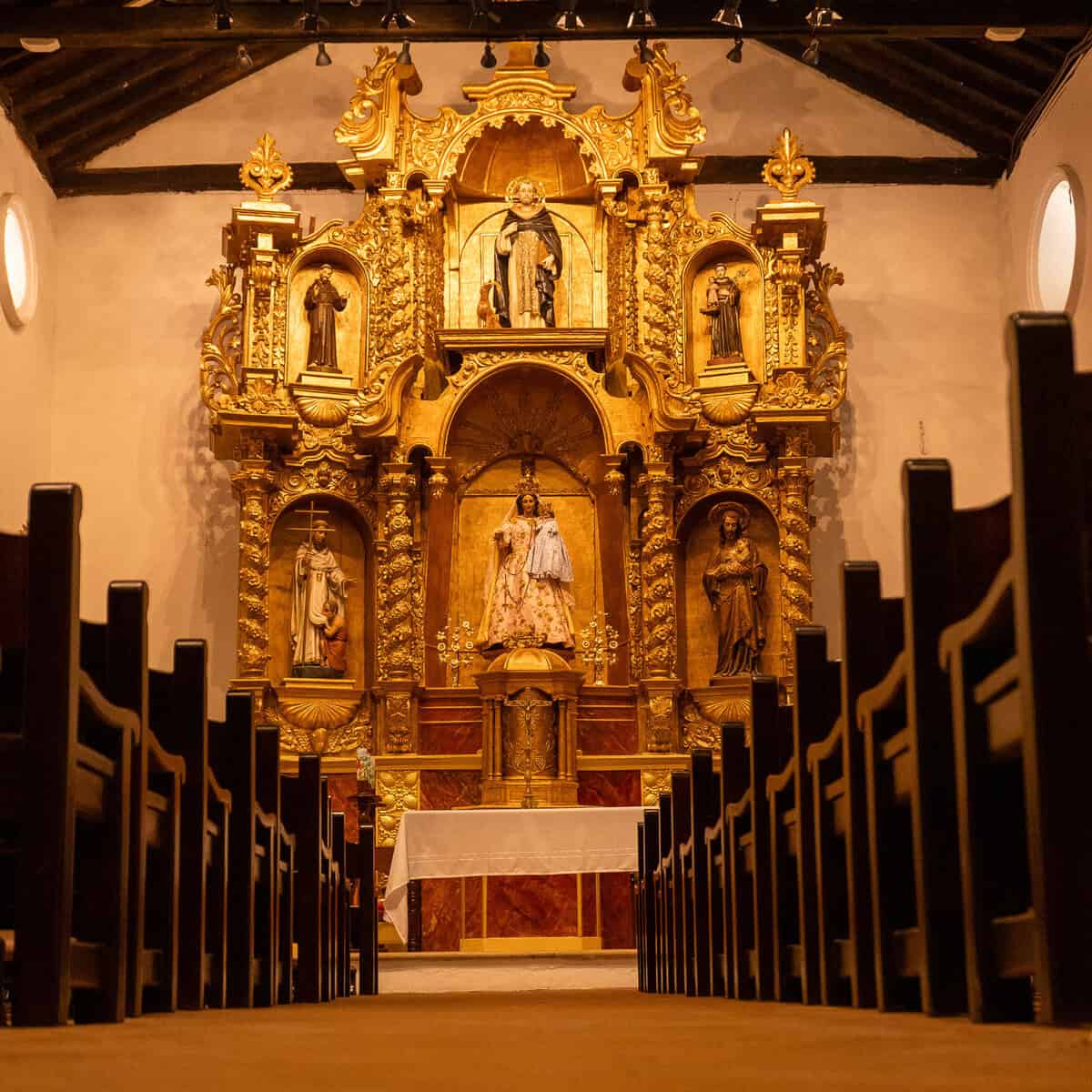
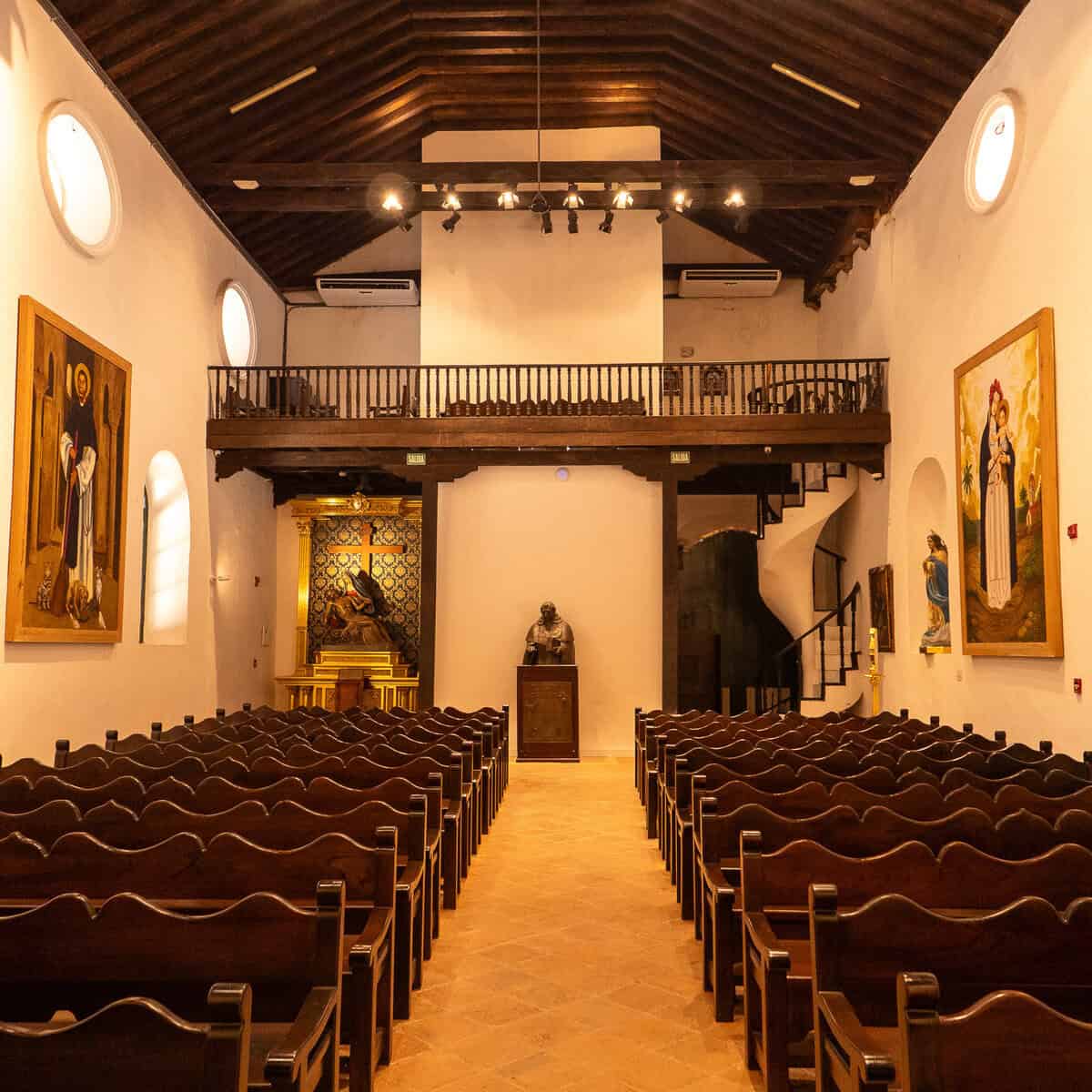
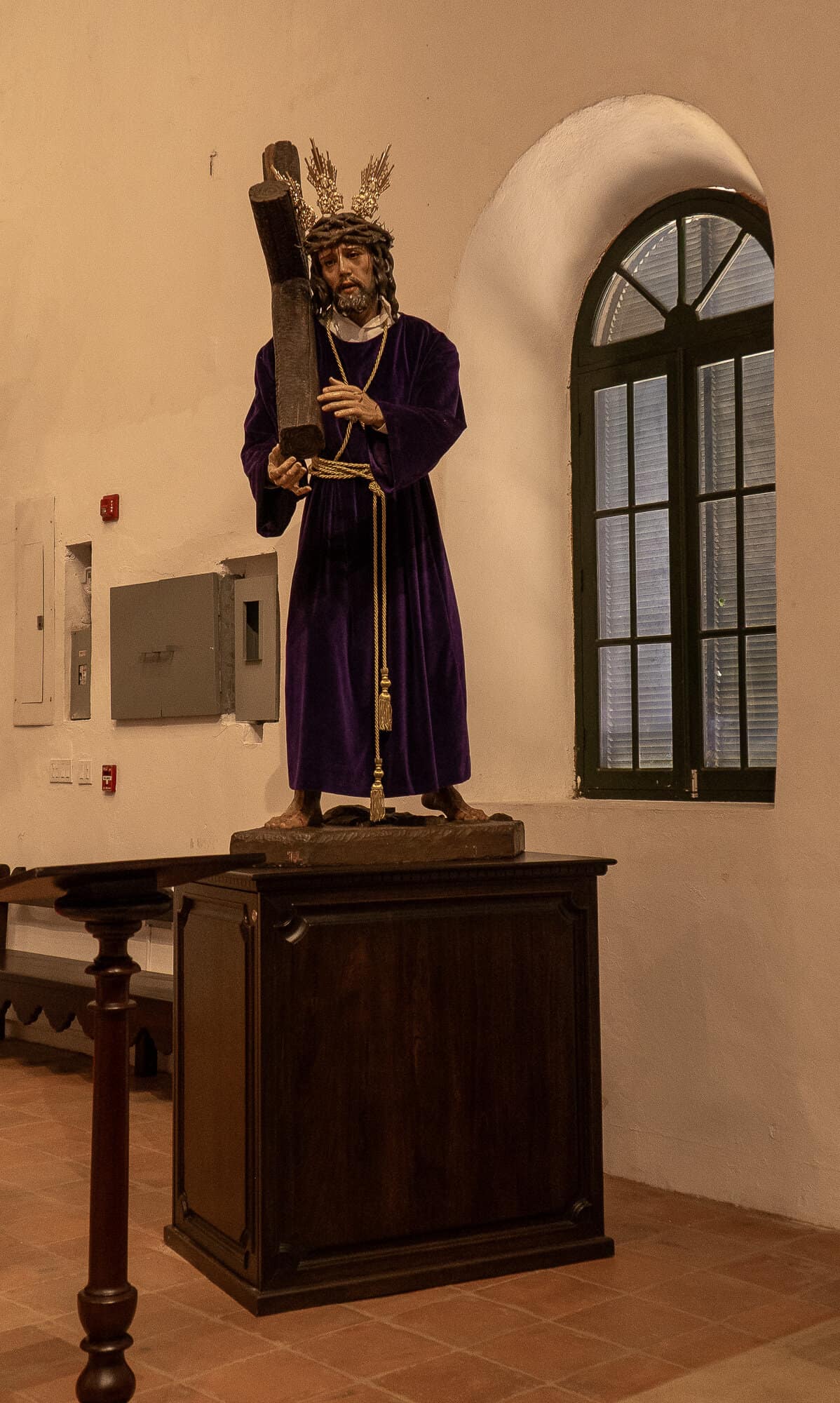
There is an attractive altar, religious artwork, statues, wooden pews, and a simple timber ceiling. Everything is clean and carefully presented. Yet this is not an interior I would place alongside the great Churches of Casco Viejo. I think visitors should understand that before deciding where to spend their time.
That is particularly important if Santo Domingo happens to be the first church you enter.
Walk a little farther through Casco Viejo and you can experience the Golden Altar at San José or the remarkable history of La Merced. You can appreciate the scale of the Metropolitan Cathedral or discover the beautifully balanced interior of San Felipe Neri. Each offers a very different understanding of the religious heritage that helped shape this neighborhood.
Santo Domingo belongs to that history, but for different reasons.
Why I Am Writing About Santo Domingo
I have always believed a travel guide should do more than tell you what exists. It should help you decide what is genuinely worth your time. After more than forty years working in hospitality and buying a home in Casco Viejo since 2008, I take that responsibility seriously.
So this isn’t going to be an article telling you Santo Domingo is magnificent simply because it is old, restored, and open to visitors. Nor am I going to dismiss a building with several centuries of history simply because its interior doesn’t overwhelm me.
Instead, I want to tell you why this site matters, what you will actually find when you arrive, and where I believe it fits into a visit to Casco Viejo.
Because sometimes the most important part of a historic church isn’t what you find inside its doors.
At Santo Domingo, much of the remarkable story is standing right beside them.
The Dominican Story Behind Santo Domingo Church Casco Viejo
To understand Santo Domingo Church Casco Viejo, you have to go back to the beginning of the city around it. When Panama City was relocated in 1673, following the destruction of Panamá Viejo, religious orders were given important positions within the new settlement. The Dominicans established themselves on a substantial site near what is now Avenida A.
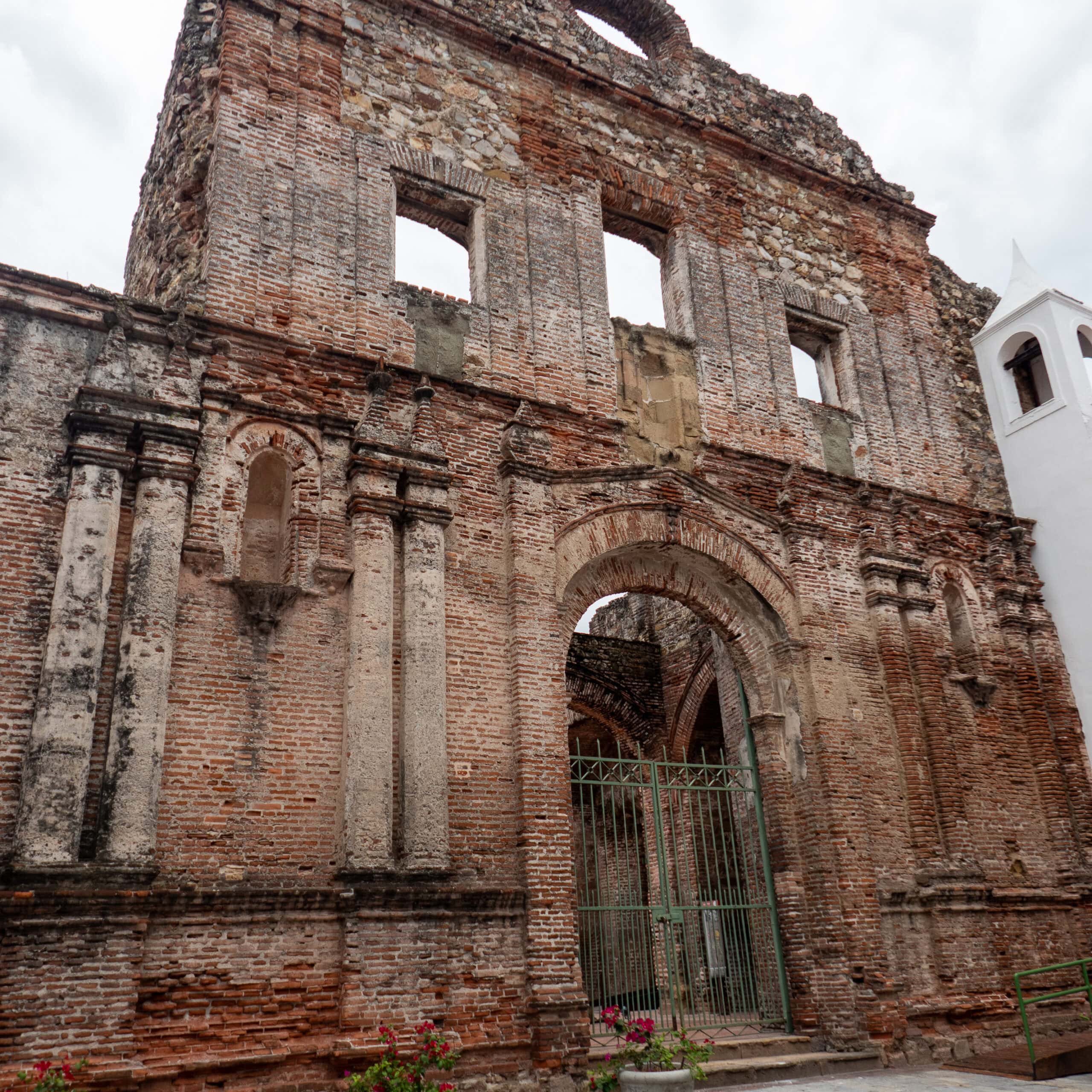
Their original complex was considerably larger than the church visitors see today. It included a convent and a substantial church arranged around the religious and community life of the Dominican order. What now appears as a romantic collection of brick ruins was once part of a functioning institution within the new city.
This was still a compact, fortified settlement surrounded by walls and facing the sea. Churches were not simply architectural landmarks within that world. They were woven into education, worship, community life, and the social structure of colonial Panama.
When Fire Changed Santo Domingo
Casco Viejo has been shaped almost as much by what it lost as by what survived. Fire repeatedly swept through the densely built city, where wooden roofs and closely packed buildings made destruction particularly difficult to contain.
Santo Domingo suffered heavily during the major fires of 1737 and 1756. The second fire proved especially devastating to the Dominican church. Its wooden roof was destroyed, leaving the great masonry walls exposed to Panama’s tropical weather.
The Dominicans repaired portions of their complex, but the large church was never completely rebuilt. Instead, a smaller chapel was constructed alongside the ruins. That decision created the unusual relationship visitors encounter today.
You are not simply looking at an old church beside some unrelated ruins. Both belong to the same Dominican story, separated by destruction, necessity, and centuries of change.
Why the Ruins Still Matter
There is something particularly powerful about historic ruins when they are allowed to remain understandable. Santo Domingo does that remarkably well. The surviving walls give you enough of the original structure to appreciate its scale without pretending the building survived intact.
Stand within them, and you can begin to imagine the church that once occupied the space. The height of the brickwork reveals its proportions, while the open sky marks everything that disappeared. For me, this is where Santo Domingo becomes genuinely compelling.
Casco Viejo contains beautifully restored buildings, but restoration inevitably changes our relationship with the past. Walls are repaired, surfaces cleaned, roofs replaced, and interiors returned to life. At Santo Domingo, the ruins allow you to see something different.
They show what happens when history isn’t completely repaired away. And among those surviving walls was an architectural feature that would eventually give this Dominican complex significance far beyond Casco Viejo.
That feature was the Arco Chato, the Flat Arch.
The Arco Chato and Its Unexpected Place in Panama Canal History
Of everything connected with Santo Domingo, the Arco Chato, or Flat Arch, has the most remarkable story. Built within the original Dominican church, the brick arch stretched more than eleven meters while rising only slightly across its span.
That unusual construction would eventually matter for reasons nobody could have imagined when it was built.
An Arch That Became Part of the Canal Debate
During the nineteenth century, the United States had not yet decided whether its interoceanic canal should cross Panama or Nicaragua. Earthquakes and volcanic activity were important concerns, particularly when considering the enormous engineering investment required.
Philippe Bunau-Varilla, one of the strongest advocates for the Panama route, recognized the usefulness of the Arco Chato. The slender masonry arch had survived for generations, despite appearing remarkably vulnerable to seismic movement.
Its survival became part of the argument that Panama offered greater geological stability than Nicaragua.
The Flat Arch did not single-handedly bring the Panama Canal to Panama. The final decision involved politics, engineering, geography, money, and considerable lobbying. However, this small piece of architecture in Casco Viejo became part of that much larger international campaign.
The Arch Visitors See Today
There is one detail visitors should know.
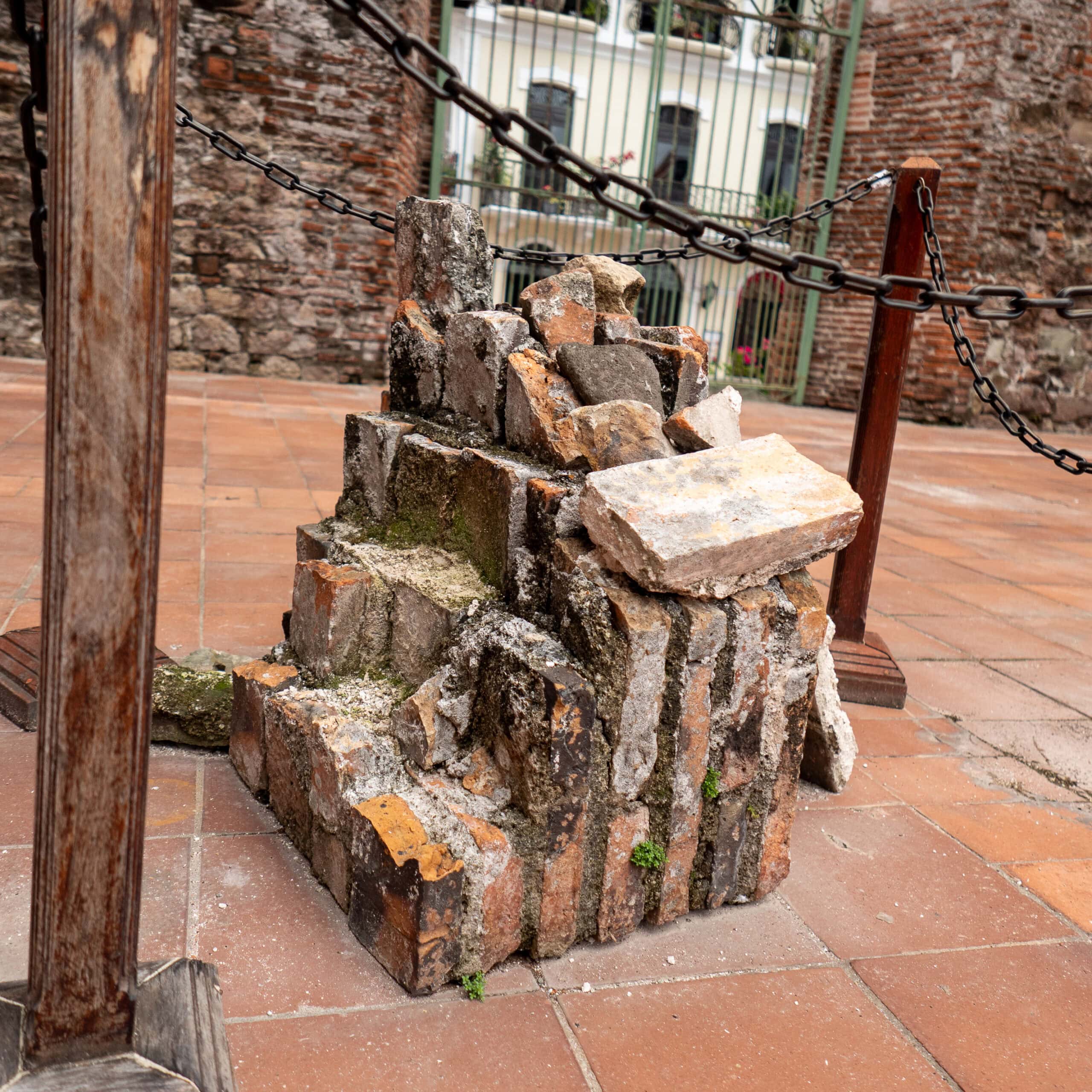
The original Arco Chato eventually collapsed in November 2003 after surviving for centuries. It was subsequently reconstructed using historical documentation, photographs, and surviving materials recovered from the site.
That doesn’t make its story less important, but it does change what you are looking at today. The arch standing within the ruins is a reconstruction of the famous original. Its significance comes from the structure that occupied this exact space and the extraordinary role it played in Panama’s history.
For me, that context makes the Arco Chato far more interesting than simply photographing an unusual brick arch. It connects this quiet corner of Casco Viejo with one of the greatest engineering and political decisions of the modern era.

From Museum Space Back to a Working Church
For much of recent history, the smaller building beside the Santo Domingo ruins served a very different purpose. Rather than functioning primarily as a church, it housed Panama’s Museo de Arte Religioso Colonial for approximately fifty years.
That helps explain why many longtime residents never regarded Santo Domingo as one of Casco Viejo’s active churches. The building was historic, certainly, but its public identity had become associated with the museum and its collection.
That arrangement began changing recently. The government collection was relocated, and the building was returned to the Catholic Church. During Holy Week in 2025, Santo Domingo once again became part of the religious life of Casco Viejo.
Watching the Church Come Back to Life
Living nearby gave me an interesting perspective on that transition. It didn’t happen with one dramatic reopening that suddenly transformed the building. Instead, the changes appeared gradually.
I began seeing furniture moved inside and religious objects taking their places. The interior slowly started looking less like a former museum space and more like a functioning Catholic church.
Eventually, the doors were open, and visitors could walk inside again.
There is something worthwhile about seeing a historic building return to the purpose for which it was originally intended. Casco Viejo has plenty of old buildings whose uses have changed completely over the centuries. Having a religious building return to worship adds another layer to the neighborhood’s continuing story.
A New Chapter for Santo Domingo
That recent change also means Santo Domingo is still finding its place within today’s Casco Viejo.
It should not be judged as though visitors have been entering the same established church experience for decades. What we see today is relatively new, even though the building itself is centuries old.
That distinction is important. The history is established. The present-day visitor experience is still evolving. And now that the doors are open again, the obvious question is what you actually find when you step inside.
Inside Santo Domingo Church Casco Viejo
Walking into Santo Domingo Church Casco Viejo after seeing the enormous ruins outside creates an interesting contrast. The interior is considerably smaller and more restrained than the historic setting surrounding it might lead you to expect.
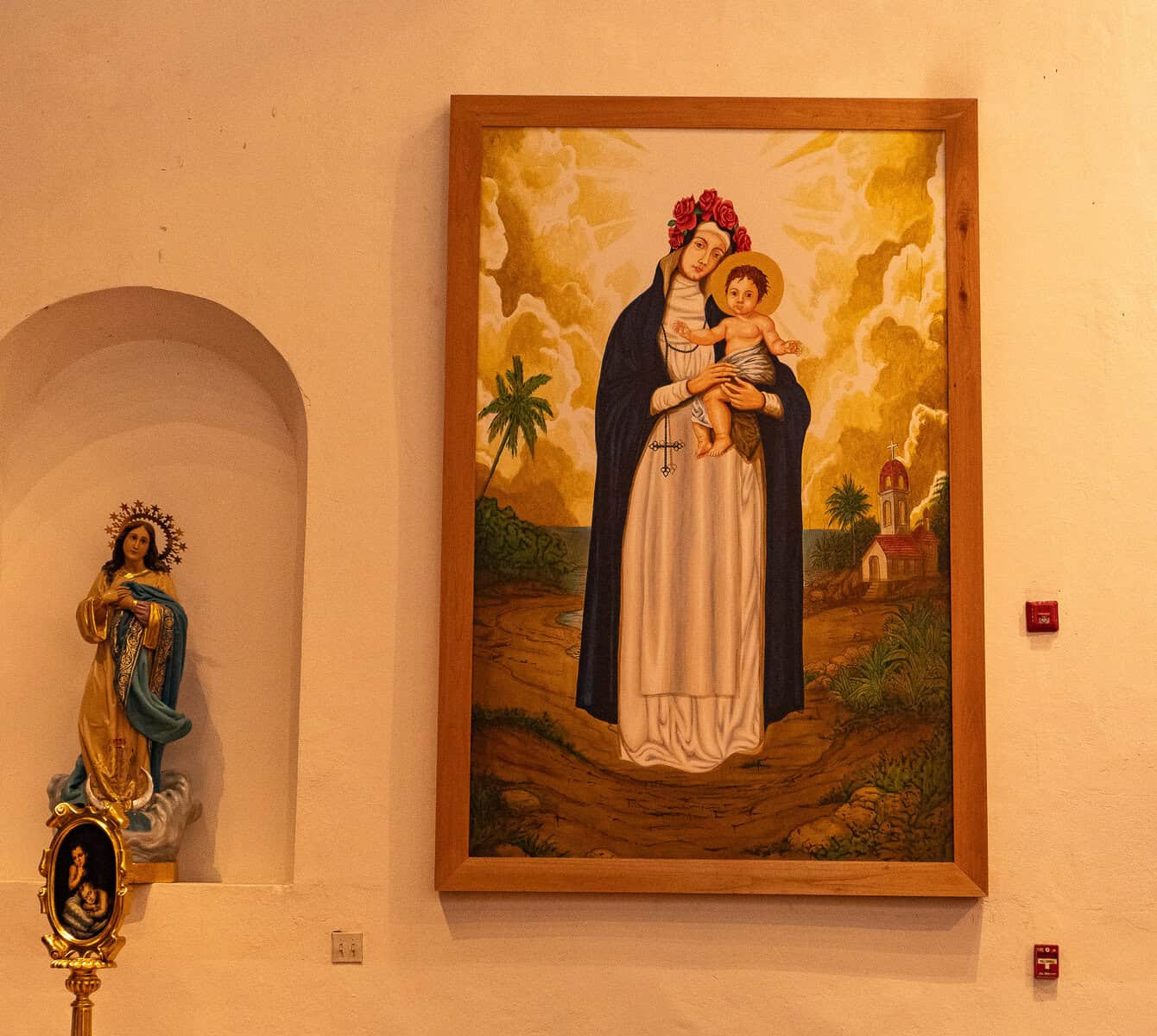
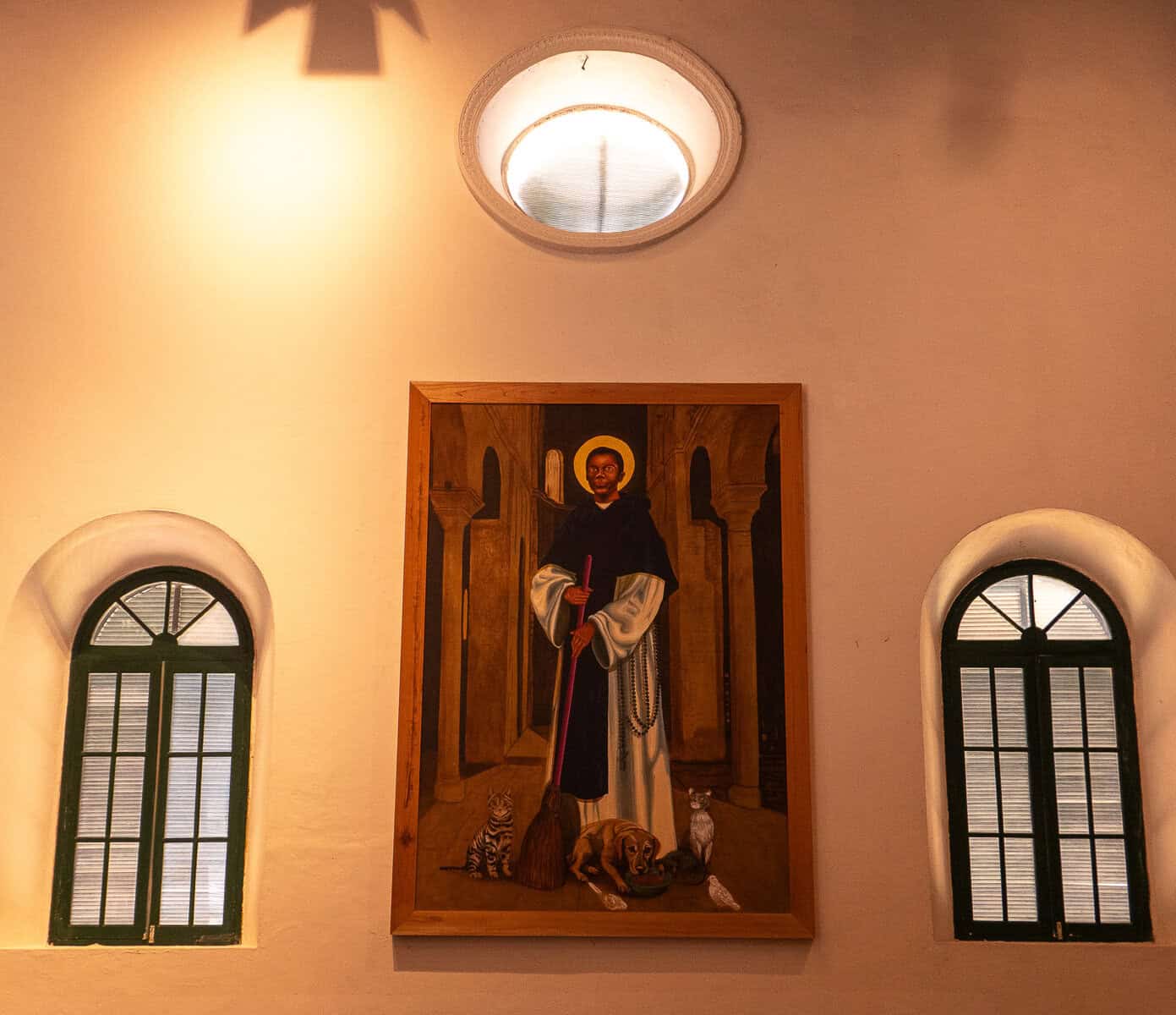
The first thing you notice is how simple the room feels. White walls frame a central aisle lined with dark wooden pews, while the exposed timber ceiling adds warmth overhead. Religious paintings and devotional figures are positioned around the church, with the main altar providing the strongest visual focus.
It is pleasant, orderly, and clearly cared for. But it doesn’t have the architectural drama found inside some of Casco Viejo’s other churches.
The Altar Is the Natural Focal Point
Your eye is immediately drawn toward the gilded retablo at the end of the nave. Against the simplicity of the surrounding walls, its gold detailing stands out beautifully.
This is where I would spend most of my time inside.
Look closely at the religious figures and decorative details rather than simply photographing the altar from the entrance. The contrast between the elaborate retablo and the restrained interior around it gives the church much of its character.
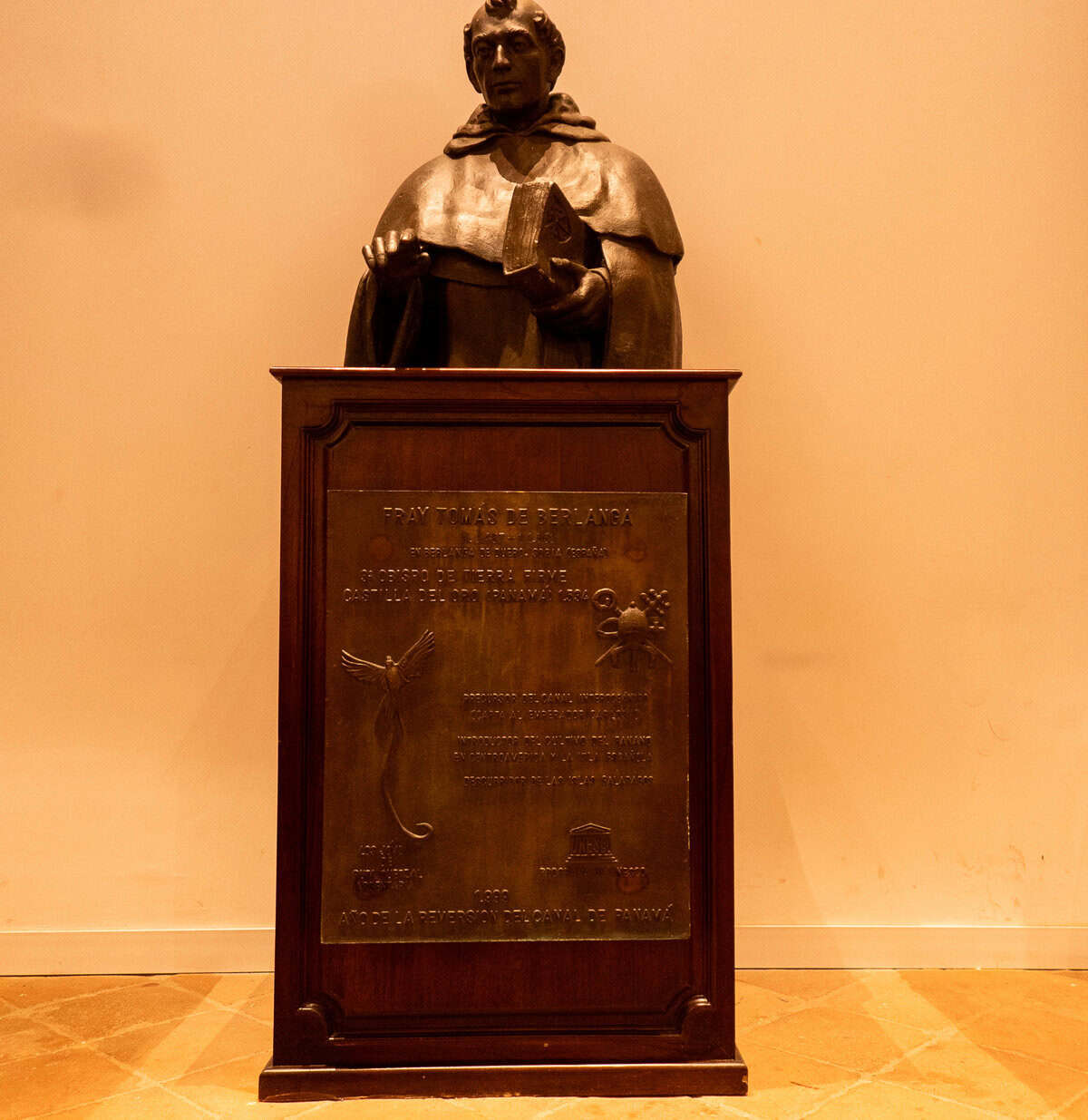
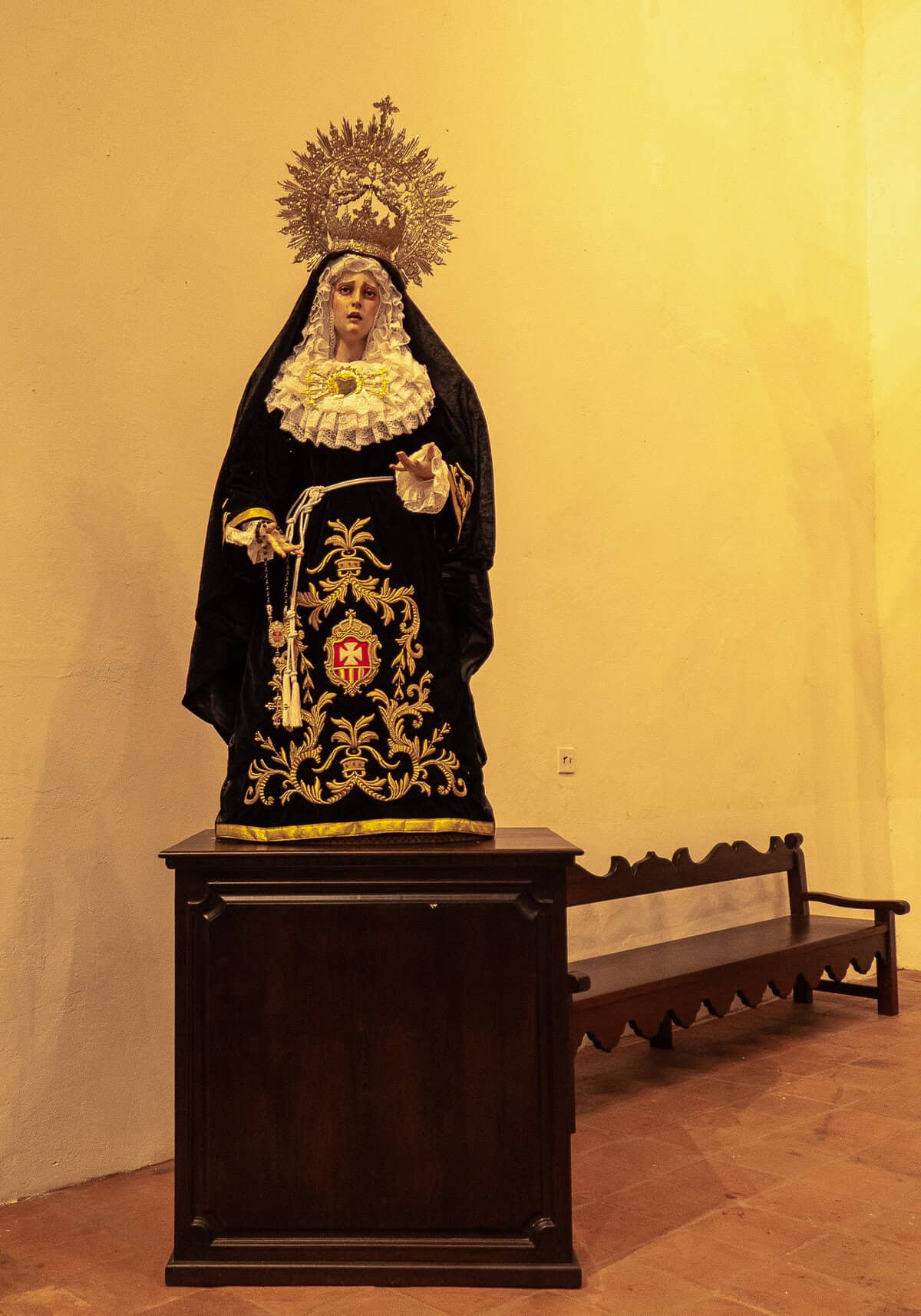
Around the nave, you will also find religious paintings and statues representing familiar Catholic traditions. Together, they create the atmosphere of a small working church rather than a monumental ecclesiastical interior.
A Church You Can Appreciate Quite Quickly
For most visitors, this is not somewhere that requires twenty or thirty minutes to understand. You can walk the nave, examine the altar, look at the artwork, and take in the architecture within several minutes. Someone with a particular interest in Catholic art or Dominican history may naturally stay longer.
There is nothing wrong with a church being modest. In fact, smaller religious spaces can sometimes be the most affecting.
My hesitation with Santo Domingo is different.
The extraordinary history you encounter outside creates expectations that the interior doesn’t necessarily fulfil. That doesn’t diminish the church’s religious purpose, but it does matter when considering it as a visitor attraction. And that distinction becomes particularly important when Santo Domingo is compared with the other historic churches only a short walk away.
Fast Facts Iglesia Santo Domingo de Guzmán
- Official Name: Iglesia Santo Domingo de Guzmán
- Location: Avenida A, Casco Viejo, Panama City
- Religious Order: Dominican
- Historic Origins: The Dominican complex dates to the earliest decades of Casco Viejo following the city’s relocation in 1673.
- Known For: The adjoining Santo Domingo ruins and the famous Arco Chato, or Flat Arch.
- Historic Chapel: The smaller eighteenth-century chapel was restored in 1974 and later housed Panama’s Museo de Arte Religioso Colonial.
- Return to the Church: The building was returned to the Archdiocese of Panama in 2024.
- Reopened to Visitors: Santo Domingo reopened progressively, with public access beginning during Holy Week 2025.
- Main Interior Feature: The historic retablo of the Virgin of the Rosary, restored and blessed in August 2025.
- Current Use: Active Roman Catholic church and part of Casco Viejo’s traditional Seven Churches religious route.
- Tourist Admission: $2 per person for an individual tourist visit under the current Casco Antiguo church admission system.
- Recommended Visit Time: Around 5 to 15 minutes inside the church, with additional time for the Santo Domingo ruins and Arco Chato.
- My Recommendation: Visit if you are already exploring the Arco Chato or following the church route. I would not make it your first Casco Viejo church.
- Included On: Not currently included as a dedicated stop on the CascoViejo360 Self-Guided Walking Tour.
Frequently Asked Questions Iglesia Santo Domingo de Guzmán
Yes, but I would consider it an additional stop rather than an essential one. The adjoining Santo Domingo ruins and Arco Chato are historically significant and well worth seeing. If the church is open while you are there, step inside and experience it as part of the complete site.
Most visitors will probably need around five to fifteen minutes inside the church. Allow additional time to explore the adjoining ruins and Arco Chato.
The Santo Domingo complex is best known for its historic Dominican ruins and the Arco Chato, or Flat Arch. The unusual arch became associated with arguments supporting Panama as the location for the interoceanic canal.
No. The original Flat Arch survived for centuries before collapsing in November 2003. It was subsequently reconstructed using historical documentation and surviving materials.
No. The smaller church stands beside the ruins of the much larger Dominican church destroyed by eighteenth-century fires. Both belong to the same historic Dominican complex.
The church was returned to the Archdiocese of Panama in 2024. It reopened before the public during Holy Week in 2025.
The interior contains wooden pews, religious paintings, devotional statues, an exposed timber ceiling, and the historic retablo of the Virgin of the Rosary.
I wouldn’t make it your first. Casco Viejo has several churches offering richer architectural and visual experiences. Visit Santo Domingo after seeing some of those churches, and its place within the neighborhood’s religious history becomes easier to appreciate.
No. I haven’t included the church as a dedicated stop because every attraction on my walking tour needs to justify a visitor’s limited time. The Santo Domingo ruins and Arco Chato remain important historic sites, but I currently consider the church interior an optional addition rather than an essential stop.
Closing Thoughts Santo Domingo Church Casco Viejo
For most of my years living in Casco Viejo, Santo Domingo was a place I associated more with the ruins than the church itself. That remains true today, although seeing the building return to religious use has added another chapter to its long history.
The real strength of Santo Domingo Church Casco Viejo is its setting. Few places in the neighborhood bring together colonial history, destruction, architecture, religion, and the Panama Canal story within such a compact space. The Dominican ruins and Arco Chato give this corner of Casco Viejo an importance that reaches far beyond the church doors.
Worth Seeing, but Keep It in Perspective
If you are already visiting the Arco Chato, I would certainly look inside Santo Domingo when the doors are open. If you have a church pass, there is even more reason to include it. Spend a few minutes appreciating the restored retablo, religious artwork, and the fact that worship has returned to this historic building.
Would I make a special journey across Casco Viejo simply to see the church interior? Probably not.
That isn’t meant to diminish its religious importance. A functioning church serves a purpose considerably greater than entertaining visitors. But when I recommend places through CascoViejo360, I also have to consider the experience from a traveler’s perspective.
Don’t Let This Be Your Only Casco Viejo Church
If Santo Domingo is the first church you encounter, keep exploring.
Casco Viejo has churches with extraordinary architecture, centuries of accumulated character, remarkable restoration stories, and interiors capable of stopping you in your tracks. They are part of what makes walking this neighborhood so rewarding.
Santo Domingo contributes something different. Come for the history surrounding it. Stand beneath the Arco Chato and understand why this unusual structure became part of Panama’s much larger story. Look at the ruined walls and imagine the Dominican church that once filled that space.
Then, if the doors are open, step inside. Just don’t stop exploring there.
For me, that is the fairest way to appreciate Santo Domingo: not as one of Casco Viejo’s essential church interiors, but as one small piece of a much more compelling historic site.
Continue Exploring Casco Viejo
Thank you for taking the time to read this guide. Iglesia Santo Domingo de Guzmán is only one chapter in the remarkable story of Casco Viejo, also known as San Felipe. The district’s churches, plazas, museums and historic streets each reveal another piece of Panama’s cultural heritage.
If you’re planning to explore further, these guides will help you discover more of Casco Viejo and Panama City:
Discover how one of Latin America’s smallest historic districts became one of Panama’s most important cultural, hospitality and culinary destinations.
Make the most of your visit with practical advice on where to stay, what to see and how to experience Panama City in just a few days.
Explore more in-depth articles covering Casco Viejo’s history, architecture, culture, restaurants and the people who make this UNESCO World Heritage district so unique.
I hope this guide helps you better understand Iglesia Santo Domingo de Guzmán and its place within the history of Casco Viejo. Like so much of this neighborhood, its story is best appreciated as part of the much larger story that surrounds it.
James P. Rice
Founder & Publisher, CascoViejo360.com
info@CascoViejo360.com
Casco Viejo Walking Tour
Explore Casco Viejo at your own pace with a flexible self-guided walking route designed for your phone.
- No groups, no schedules
- Start anywhere, stop anywhere
- Works on phone or desktop
Panama City In 24 Hours
A carefully paced local itinerary for travelers with limited time who still want to experience Panama properly.
- Arrival day made simple
- Rooftops, dining & local rhythm
- Smart airport timing
Three Nights & Four Days
A flexible Panama itinerary centered around Casco Viejo, designed to help you arrive calmly and plan with confidence.
- Casco Viejo as your base
- Smart day trips and dining
- Timing without overplanning
Meetings in Casco Viejo, Panama
For planners looking beyond ballrooms. Boutique hotels, rooftop receptions, walkable dine-arounds, and real neighborhood character — this is how serious meetings get done here.
PLAN A MEETING HEREDestination Weddings in Casco Viejo
Historic churches, rooftop sunsets, colonial courtyards, and everything within walking distance. If you’re considering Panama, start here before you make a single call.
EXPLORE WEDDINGSCasco Viejo Boundaries
Where Casco truly begins, where it ends, and why that matters. If you’re booking a hotel, planning an event, or buying property — this distinction is important.
UNDERSTAND THE MAPJames P. Rice
James P. Rice purchased a home in Casco Viejo in 2008 and brings more than 40 years of hospitality, restaurant, tourism, and convention industry experience to CascoViejo360.com.
His background includes leadership positions with Ritz-Carlton and Hyatt Hotels, executive roles with major convention centers, and ownership of restaurants and pubs in both the United Kingdom and the United States.
Every article, hotel, restaurant, rooftop venue, attraction, and experience featured on CascoViejo360.com is selected through local knowledge, personal experience, and professional review, with careful consideration given to visitor experience, service standards, authenticity, and its contribution to the overall Casco Viejo and Panama City visitor experience.